2026-09-08 ノースカロライナ州立大学(NC State)
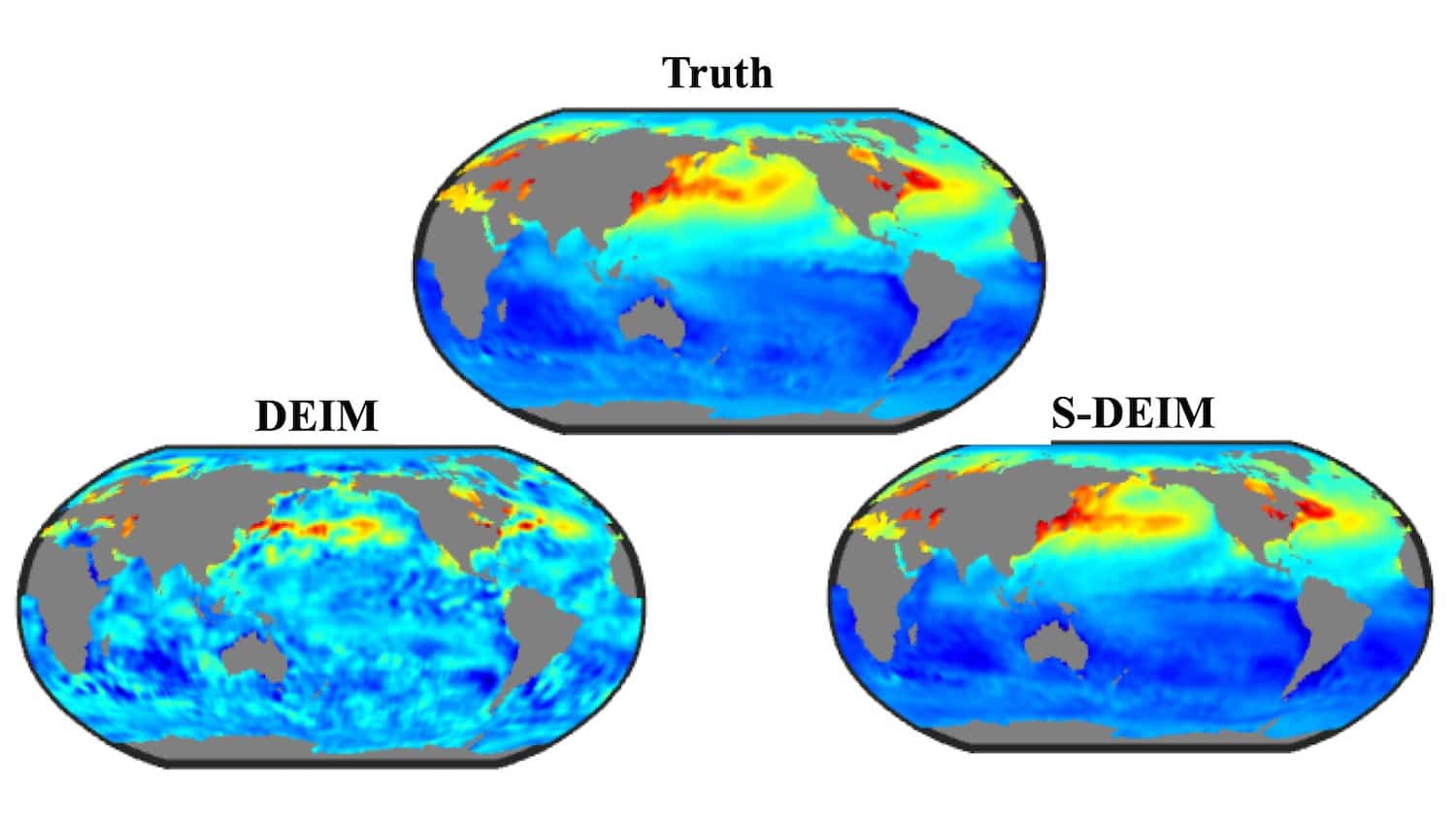
A new method, S-DEIM, improves the estimation of global sea surface temperatures from scarce observational data. Image: Mohammad Farazmand
<関連情報>
- https://news.ncsu.edu/2026/09/new-method-estimates-sea-surface-temps-quickly-and-accurately/
- https://agupubs.onlinelibrary.wiley.com/doi/10.1029/2026JH001279
疎な現場観測データに基づく地球規模の海面水温の迅速な推定 Rapid Estimation of Global Sea Surface Temperatures From Sparse Streaming In Situ Observations
Cassidy All, Kevin Ho, Maya Magnuski, Christopher Nicolaides, Louisa B. Ebby, Mohammad Farazmand
Journal of Geophysical Research: Machine Learning and Computation Published: 27 August 2026
DOI:https://doi.org/10.1029/2026JH001279
Abstract
Reconstructing high-resolution sea surface temperatures (SST) from staggered SST measurements is essential for analyzing earth system processes. However, when SST measurements are sparse, the resulting inferred SST fields are rather inaccurate. Here, we show that Sparse Discrete Empirical Interpolation Method (S-DEIM) can be used as a model-free data assimilation method to reconstruct high-resolution SST fields from sparse in situ observations. The S-DEIM estimate consists of two terms, one computed from instantaneous in situ observations using empirical interpolation, and the other learned from the historical time series of observations using recurrent neural networks (RNNs). We train the RNNs using the National Oceanic and Atmospheric Administration’s weekly high-resolution SST data set spanning the years 1989–2021 which constitutes the training data. Subsequently, we examine the performance of S-DEIM on the test data, comprising January 2022 to January 2023. For this test data, S-DEIM infers the high-resolution SST from 100 in situ observations, constituting only 0.2% of the high-resolution spatial grid. We show that the resulting S-DEIM reconstructions are about 40% more accurate than earlier empirical interpolation methods, such as DEIM and Q-DEIM. Furthermore, 91% of S-DEIM estimates fall within  C of the true SST. We also demonstrate that S-DEIM is robust with respect to sensor placement: even when the sensors are distributed randomly, S-DEIM reconstruction error deteriorates only by 1%–2%. S-DEIM is also computationally efficient: training the RNN, which is performed only once offline, takes approximately 1 minute. Once trained, the S-DEIM reconstructions are computed in less than a second.