2026-09-07 中国科学院(CAS)
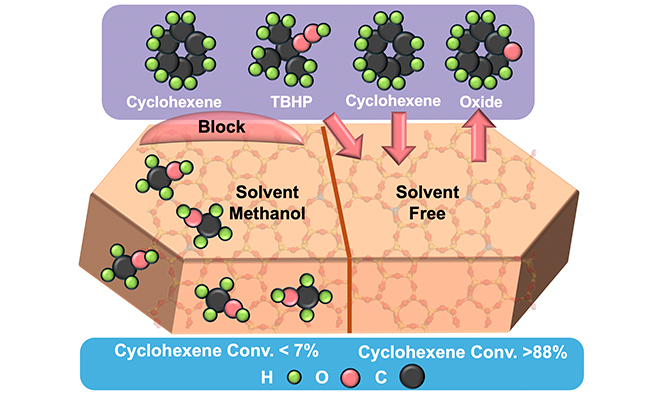
Cyclohexene conversion was below 7% in methanol but reached 88% without added reaction solvent. (Image by DICP)
<関連情報>
- https://english.cas.cn/newsroom/research-news/202609/t20260907_1192721.shtml
- https://pubs.acs.org/jacsat/article-abstract/doi/10.1021/jacs.6c12516/5416595/Solvent-Free-Catalysis-Unlocks-Bulky-Molecule
溶媒を用いない触媒作用により、チタノシリケート微細孔内での嵩高い分子の酸化が可能になる Solvent-Free Catalysis Unlocks Bulky-Molecule Oxidation within Titanosilicate Micropores
Xun Wu;Mingbin Gao;Fangxiu Ye;Liping Yang;Danhua Yuan;Shiji Li;Zhexiong Zheng;Yuhan Song;Jingfeng Han;Shutao Xu;Jiacheng Xing;Yunpeng Xu;Zhongmin Liu
The Journal of the American Chemical Society Published:September 04, 2026
DOI:https://doi.org/10.1021/jacs.6c12516
Abstract
For decades, the consensus has been that the pore dimensions of microporous titanosilicate catalysts are too small to accommodate bulky reactants, which are critical to the fine chemicals and pharmaceutical industries. This limitation has confined catalyst design to tuning pore size based on the assumption that transport and reactivity are governed mainly by framework geometry. Here, we show that solvent-free operation can instead enhance reactivity in a system where it would normally be hampered: bulky-molecule epoxidation over microporous zeolites. In cyclohexene epoxidation over conventional titanium silicalite-1, solvent-free conditions yield 88.8% conversion with >89% epoxide selectivity, whereas conversion remains below 6.9% in methanol. We attribute this contrast to the solvent-gated accessibility of confined Ti sites. Solvent molecules occupying the microporous environment block bulky substrates from reaching the internal reactive space, while vacant or weakly occupied voids allow transient access and productive epoxidation. This trend extends to larger cyclic olefins and titanium-containing porous catalysts. By eliminating solvents and boosting efficiency, our solvent-free method proves that tailoring the confined environment is as important as the framework structure to unlock reactivity in porous catalysts.