2026-09-03 合肥物質科学研究院(HFIPS)
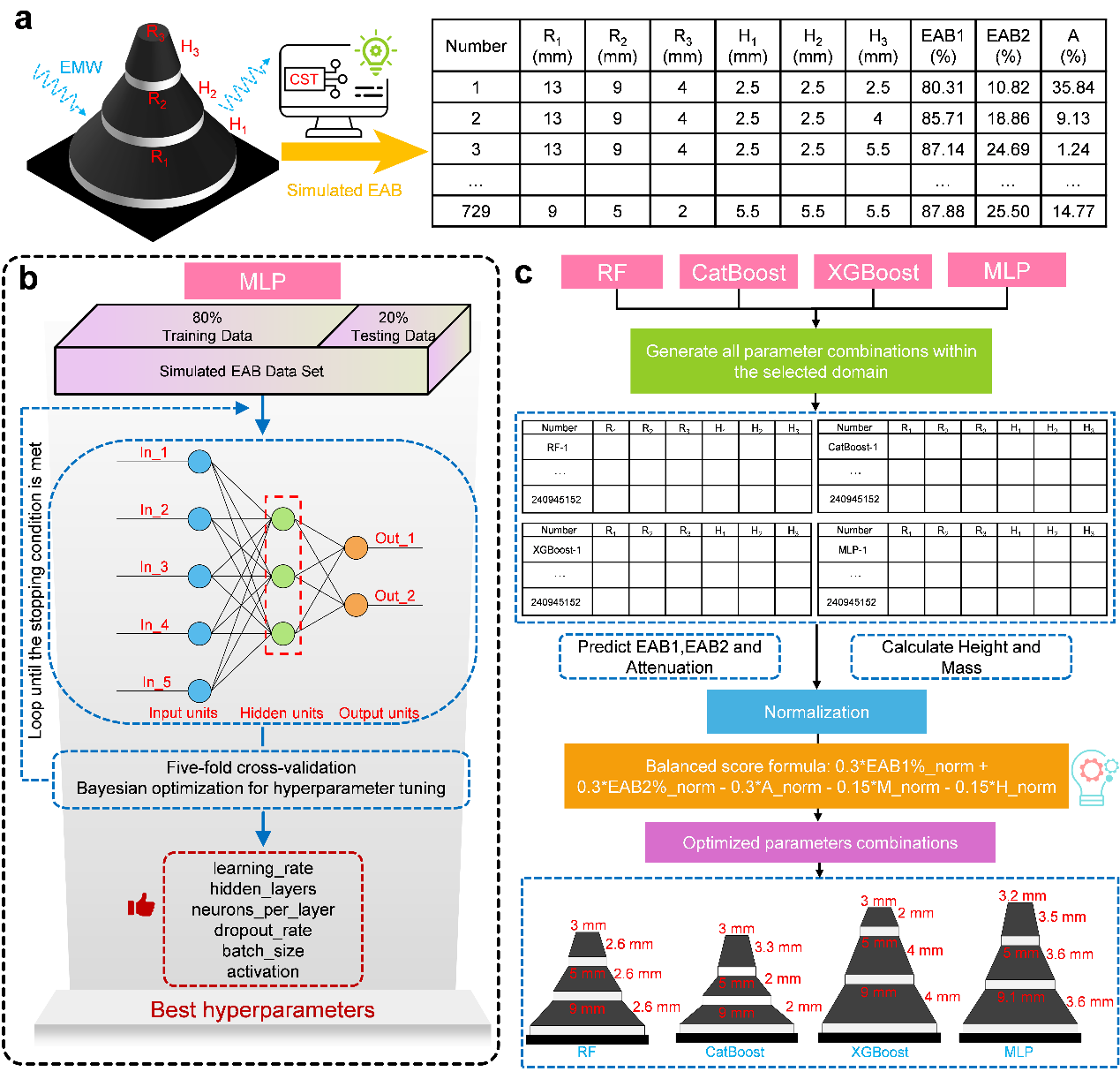
Optimization workflow for the microwave-absorbing structure based on multiple machine-learning surrogate models. (Image by XI Min)
<関連情報>
- https://english.hf.cas.cn/nr/rn/202609/t20260903_1190751.html
- https://www.sciencedirect.com/science/article/abs/pii/S138589472607765X
機械学習支援型多段共振勾配インピーダンスメタ構造による広帯域・広角マイクロ波吸収と多機能統合 Machine-learning-assisted multistage resonant gradient-impedance metastructure for broadband, wide-angle microwave absorption and multifunctional integration
Zihao Kang, Min Xi, Shudong Zhang, Cui Liu, Yaodong Wang, Dawei Zhu, Zhimei Xu, Usman Ali, Mohamed M. Salem, Nian Li, Zhenyang Wang
Chemical Engineering Journal Available online: 3 August 2026
DOI:https://doi.org/10.1016/j.cej.2026.180304
Highlights
- Machine learning with SHAP analysis optimizes gradient-impedance metastructure.
- Broadband absorption: 33.8 GHz (RL < −10 dB) and 24.83 GHz (RL < −20 dB).
- Wide-angle absorption retained: 33.01/17.12 GHz at 60° (RL < −10/−20 dB).
- Integrates electromagnetic stealth, mechanical support, and electrothermal response.
Abstract
A multistage resonant gradient-impedance metastructure was fabricated by integrating PA6/carbon-fiber composite (PACF) absorbing units, low-loss neat PA6 (N-PA) spacer layers, and a laser-induced PACF (LI-PACF) lossy reflective base through fused deposition modeling (FDM), while its optimal geometric parameters were determined by machine-learning-assisted surrogate prediction and multi-objective screening. PACF provided conductive loss, dipolar polarization, and interfacial relaxation, while the N-PA layers regulated impedance transition and interlayer coupling. Meanwhile, the LI-PACF substrate served as a functional backing layer, combining lossy reflection and additional dielectric dissipation with electrothermal capability. Benefiting from the synergistic effects of gradient impedance evolution and staged resonant complementarity, the optimized metastructure achieved a simulated effective absorption bandwidth of 33.8 GHz for reflection loss (RL) < −10 dB and 24.83 GHz for RL < −20 dB at normal incidence, with a minimum reflection loss of −43.56 dB at a thickness of 14.7 mm; experimental arch-method measurements confirmed effective absorption bandwidth (EAB) proportions of 88.94% (RL < −10 dB) and 65.47% (RL < −20 dB) under transverse electric (TE) polarization. Remarkably, under 60° TE incidence, it still retained effective absorption bandwidths of 33.01 and 17.12 GHz for RL < −10 and −20 dB, respectively. Additionally, it exhibited an average radar cross-section reduction of 23 dBsm over 2–40 GHz, together with a compressive modulus of ≈1.8 GPa, a first peak compressive strength of 129.5 MPa, and rapid deicing within 60 s at 25 V.