2026-08-25 国立天文台
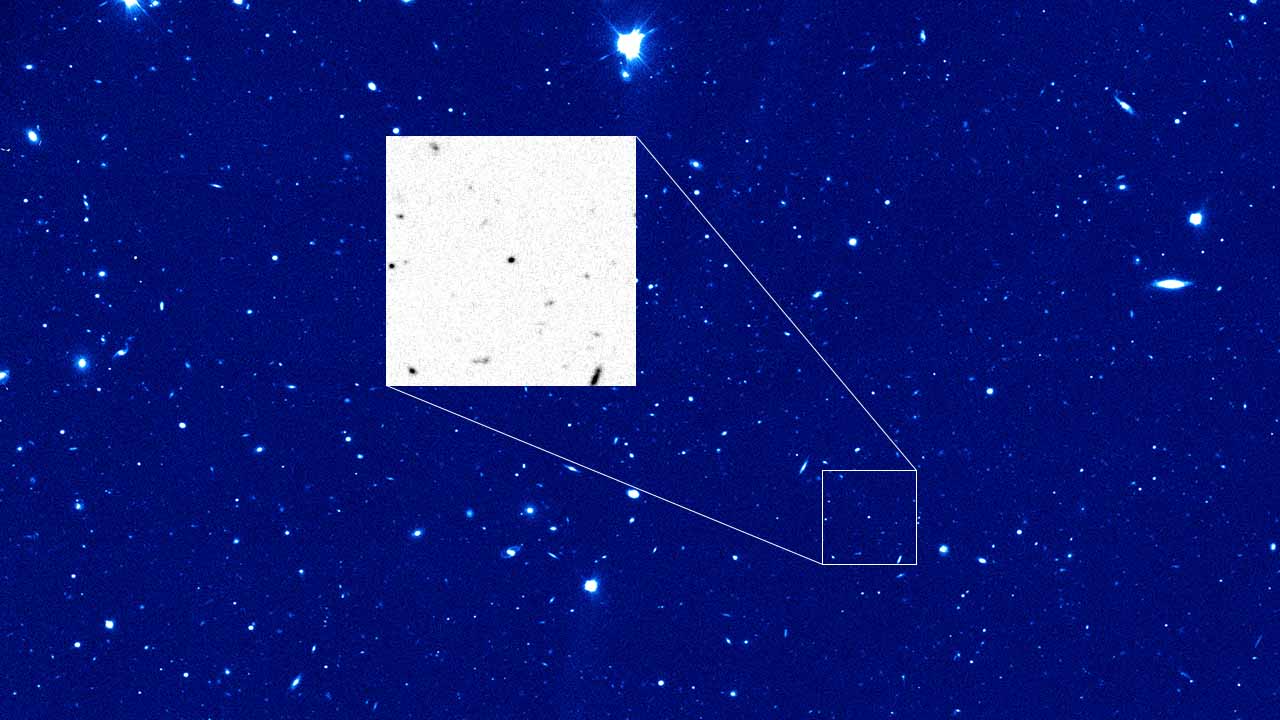
すばる望遠鏡の超広視野主焦点カメラHSCで撮影された画像に、偶然写り込んでいたネウイミン彗星(白枠の中心)。2016年3月7日(世界時)に撮影。(クレジット:国立天文台)
<関連情報>
- https://www.nao.ac.jp/news/science/2026/20260825-subaru.html
- https://academic.oup.com/pasj/advance-article/doi/10.1093/pasj/psag088/8756772
すばるハイパー・シュプリーム・カムで観測された彗星28P/ニューイミンの衝効果 Opposition effect of comet 28P/Neujmin observed with Subaru Hyper Suprime-Cam
Takafumi Ootsubo,\Hideyo Kawakita,Tadafumi Takata,Junko Furusawa,Hisanori Furusawa,Tsuyoshi Terai,Toshihiro Kasuga,Akira Keida,Yoshiharu Shinnaka,Fumi Yoshida,…
Publications of the Astronomical Society of Japan Published:25 August 2026
DOI:https://doi.org/10.1093/pasj/psag088
Abstract
We present an observational study of the nucleus of comet 28P/Neujmin at a heliocentric distance exceeding 10 au, where coma contamination is effectively minimized. Observations were conducted in the g, r, and y bands with the Hyper Suprime-Cam (HSC) on the 8.2 m Subaru Telescope. The measured colors, g-r= 0.67±0.17 and r-y=0.41±0.19,yield a spectral index of S’=8,8±4.2%/100nm, comparable to that of D-type asteroids. By incorporating new observational data at a phase angle α=0°.334 with previous bservations, we determined the phase function for the nucleus of 28P and confirmed an opposition surge at small phase angles. The derived opposition effect amplitude depends on the adopted phase coefficient, which is uncertain due to potential systematic effects in multiapparition phase curves. Nevertheless, even under conservative assumptions, the opposition effect of 28P suggests a larger coherent backscattering contribution than is typical for C- and D-type asteroids. The Subaru HSC observations suggest that, although the nucleus color resembles that of D-type asteroids, the surface microstructure of comet 28P’s nucleus likely differs from those of C- and D-type asteroids. Future single-apparition observations covering a wide phase angle range from near-opposition to larger angles, combined with polarimetric measurements, will be essential to definitively establish the physical mechanisms responsible for the opposition effects of cometary nuclei.