2026-08-21 岡山大学,科学技術振興機構
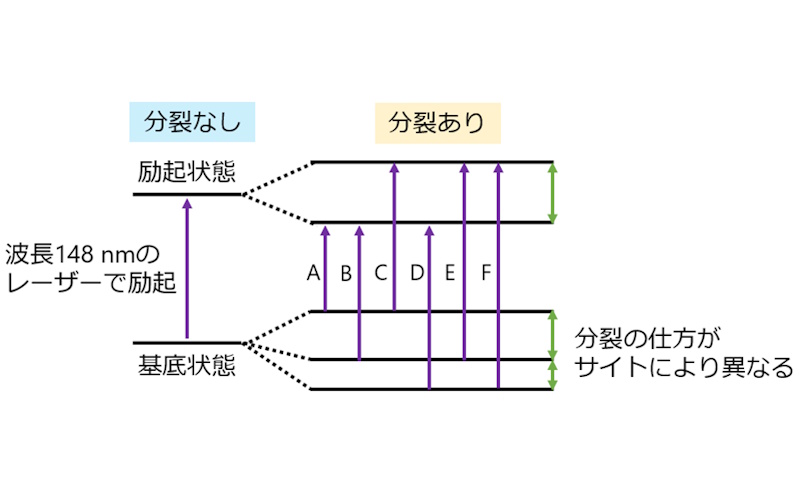
図1トリウム229原子核の基底状態と励起状態の分裂の様子
<関連情報>
- https://www.okayama-u.ac.jp/tp/release/release_id1591.html
- https://www.science.org/doi/10.1126/science.aea7978
CaF₂中の229Thのレーザーメスバウアー分光法 Laser Mössbauer spectroscopy of 229Th in CaF2
Takahiro Hiraki, Takahiko Masuda, Sayuri Takatori, Fabian Schaden, […] , and Koji Yoshimura
Science Published:20 Aug 2026
DOI:https://doi.org/10.1126/science.aea7978
Abstract
Mössbauer spectroscopy is widely used in chemistry, geology, and solid-state physics to probe the local physical and chemical environment of nuclei in materials. Here, we extended this technique into the optical range using a vacuum ultraviolet laser to probe the low-energy nuclear transitions of thorium-229 (229Th) doped in calcium fluoride (CaF2) crystals. We discovered four distinct doping sites for the thorium ions, determined the characteristic electric field gradients emerging from the interaction with the host crystal, and identified the microscopic structure of the two dominant configurations. Site-selective laser excitation enabled the study of the isomeric state lifetime and laser-induced quenching for all sites. This technique provides a powerful probe of the nuclear environment, yielding foundational data for designing future solid-state nuclear clocks.