
2026-08-19 中国科学院(CAS)
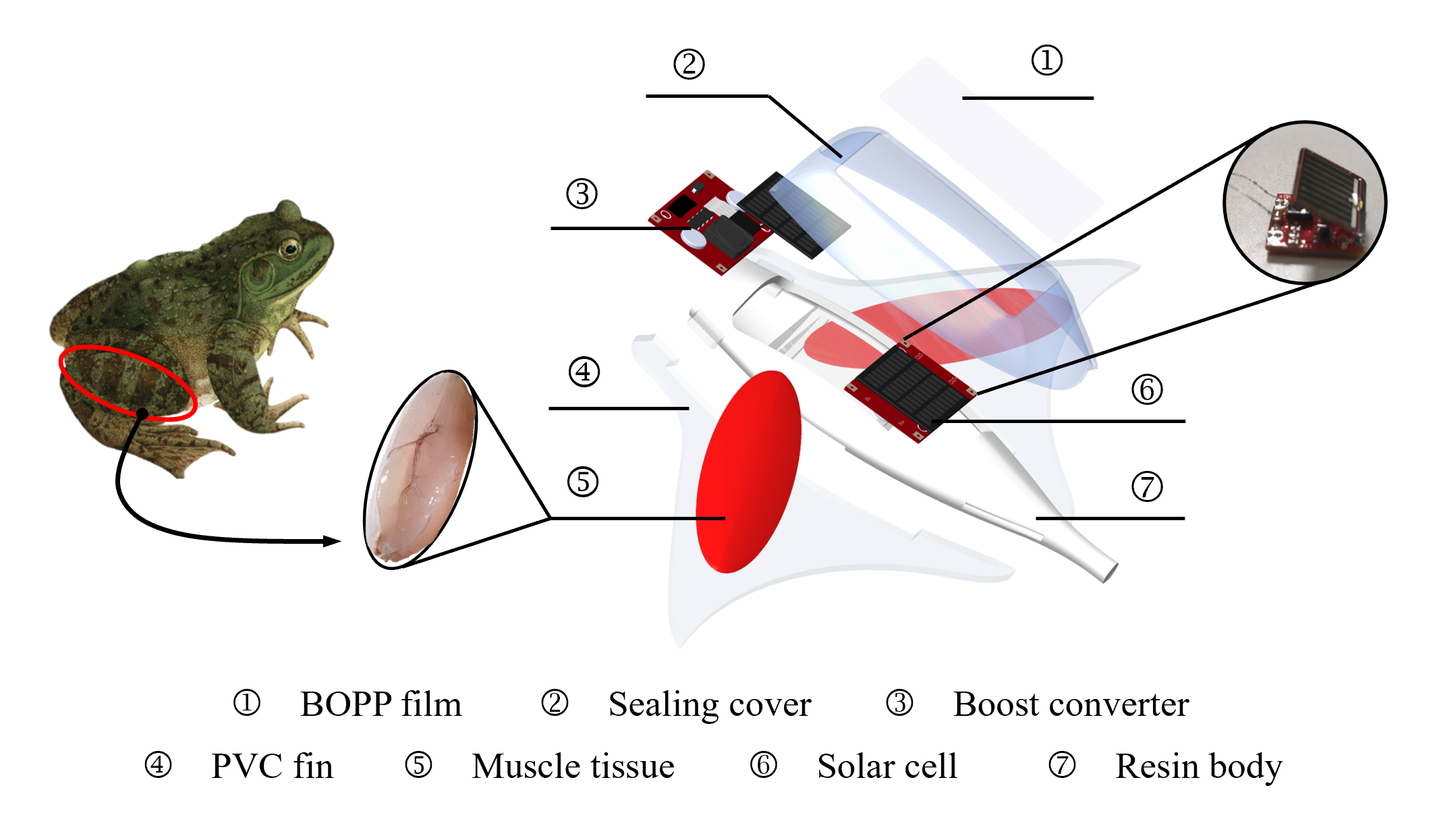
Model of the biosyncretic manta ray (Image by SIA)
<関連情報>
- https://english.cas.cn/newsroom/research-news/202608/t20260819_1188609.shtml
- https://advanced.onlinelibrary.wiley.com/doi/10.1002/adfm.77713
高機動性無線光制御生体融合マンタレイ High-Mobility Wireless Light-Controlled Biosyncretic Manta Ray
Qi Zhang, Chuang Zhang, Lianchao Yang, Yiwei Zhang, Hengshen Qin, Qin Chen, Wenjun Tan, Lianqing Liu
Advanced Functional Materials Published: 13 August 2026
DOI:https://doi.org/10.1002/adfm.77713
ABSTRACT
Biosyncretic robots hold great promise for intelligent actuation but face challenges, including low output force of artificial muscle tissues, poor mobility, and restricted movement scenarios. To address these issues, we develop a wireless light-controlled biosyncretic manta ray driven by Rana catesbeiana gracilis muscles. Under the optimal electrical stimulation conditions (1 Hz, 5 V, 10 ms), the muscle exhibited outstanding contractile performance (contractile force: 6.5 N; strain: 0.25). The robot integrates a gallium arsenide solar cell module that converts a near-infrared laser into electrical energy. The generated electrical signals are delivered to the nerves on the muscle surface, thereby stimulating muscle contraction and driving the pectoral fin flapping. Performance tests demonstrate that the robot achieves a high swimming velocity (average linear velocity of 0.54 body length s−1), excellent maneuverability and agility (minimum turning radius of 0.8 body length), a maximum turning angular velocity of 21°s−1, and environmental adaptability in water-related scenarios (water surface, underwater with load), with limited locomotion on rigid ground. This study validates isolated skeletal muscle as a high-performance biological actuator, providing a novel paradigm for high-mobility biosyncretic robots and advancing their practical application.

