2026-08-20 中国科学院(CAS)
<関連情報>
- https://english.cas.cn/newsroom/research-news/202608/t20260820_1188660.shtml
- https://www.aanda.org/articles/aa/full_html/2026/08/aa60763-26/aa60763-26.html
3つの銀河が合体した高輝度赤外線銀河UGC 2369Sに埋もれた活動銀河核の存在を示すVLBIによる直接的な証拠 Direct VLBI evidence for a buried active galactic nucleus in the triple-merger luminous infrared galaxy UGC 2369S
Wancheng Xu, Sándor Frey, Lang Cui and Krisztina Éva Gabányi
Astronomy & Astrophysics Published:04 August 2026
DOI:https://doi.org/10.1051/0004-6361/202660763
Abstract
Context. UGC 2369S is a luminous infrared galaxy (LIRG) undergoing a late-stage merger in a triple system, where the heavily obscured northern core is suspected to host an active galactic nucleus (AGN). However, severe dust and gas obscuration makes definitive confirmation challenging.
Aims. We aim to provide direct observational evidence for the buried AGN through high-resolution radio imaging, while investigating the AGN accretion and feedback properties within this merger-driven gas-rich environment.
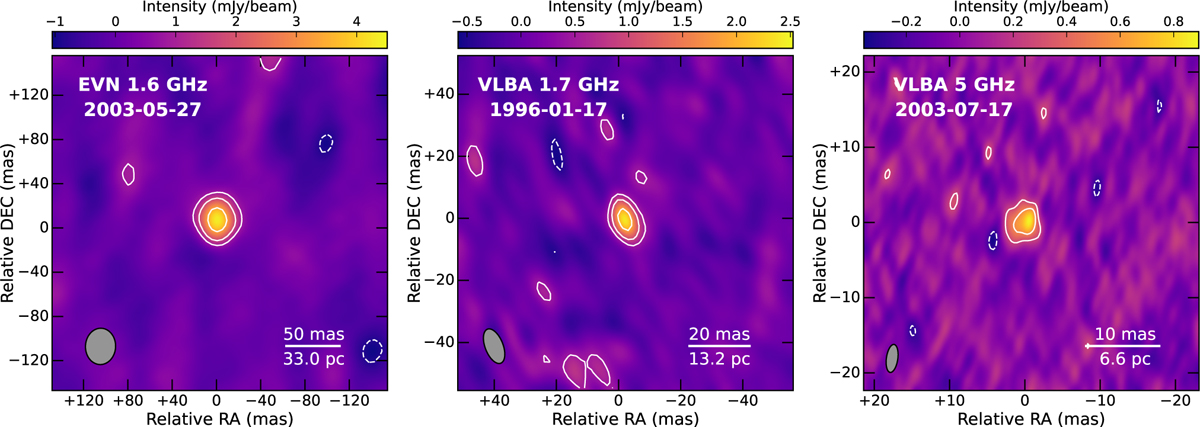
Methods. We analyzed archival European VLBI Network (1.6 GHz) and Very Long Baseline Array (1.7 and 5 GHz) data of UGC 2369S. Through high-resolution imaging and visibility-domain Gaussian modeling, we characterized the morphology and intensity of its milliarcsecond-scale radio emission.
Results. A compact radio component is detected in the northern core, exhibiting high brightness temperatures (Tb > 107 K) and a flat radio spectrum (α ≈ −0.45), which confirms the presence of an obscured AGN. The sub-Eddington accretion rate (λEdd ≈ 2.7 × 10⁻⁴) indicates that it falls within the radiatively inefficient accretion flow state.
Conclusions. We provide direct imaging evidence for an AGN in the northern core of UGC 2369S, revealing a deeply buried, jet-emitting low-luminosity AGN enshrouded by a Compton-thick gas cocoon. This demonstrates that VLBI is a uniquely effective tool for disentangling nuclear accretion and feedback processes within the heavily obscured environments of multiple-merger systems.