2026-08-20 コペンハーゲン大学(UCPH)
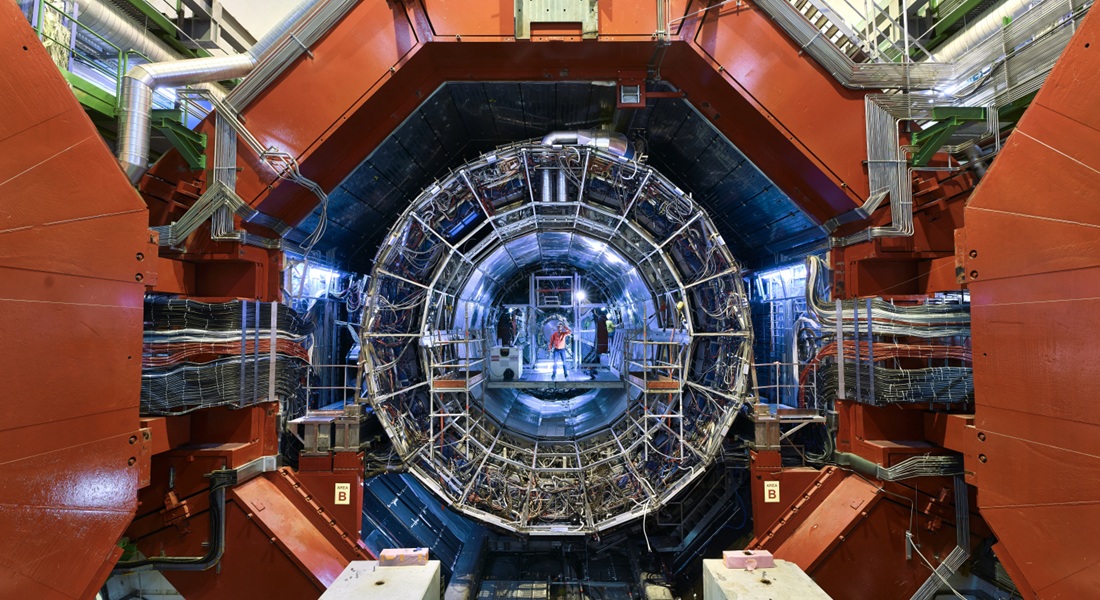
The ALICE detector at CERN (credit: Julien Ordan/CERN)
<関連情報>
- https://news.ku.dk/all_news/2026/08/researchers-create-a-little-big-bang-bowling-pin-shaped-nuclei-shed-new-light-on-the-universes-first-moments/
- https://journals.aps.org/prl/abstract/10.1103/gymp-vp87
核幾何学駆動異方性流れの証拠O+OそしてNe+Ne衝突事故√SNN=5.36 TeV Evidence of Nuclear Geometry-Driven Anisotropic Flow in O+O and Ne+Ne Collisions at √SNN=5.36 TeV
I. J. Abualrob, S. Acharya, G. Aglieri Rinella, L. Aglietta, N. Agrawal, Z. Ahammed, S. Ahmad, I. Ahuja, Z. Akbar et al. (ALICE Collaboration)
Physical Review Letters Published: 17 August, 2026
DOI: https://doi.org/10.1103/gymp-vp87
Abstract
A central question in strong-interaction physics, governed by quantum chromodynamics (QCD), is whether femtoscale droplets of quark-gluon plasma form in small collision systems involving projectiles significantly smaller than heavy ions. Collisions of light ions such as 16O and 20Ne offer a unique opportunity to probe the emergence of collective behavior in QCD matter. This Letter presents the first measurements of the elliptic (ν2) and triangular (ν3) flow of charged particles in 16O–16O and 20Ne–20Ne collisions at a center-of-mass energy per nucleon pair of √SNN=5.36 TeV with the ALICE detector. The hydrodynamic model predictions, explicitly incorporating the nuclear structures of 16O and 20Ne, exhibit a good agreement with the flow measurements presented. The observed increase of ν2 in central Ne–Ne collisions relative to OO collisions, driven by the nuclear geometries, highlights the importance of utilizing light nuclei with well-defined geometric shapes to constrain the initial conditions. These findings support the presence of nuclear geometry-driven hydrodynamic flow in light-ion collisions at the LHC.