2026-08-20 東北大学
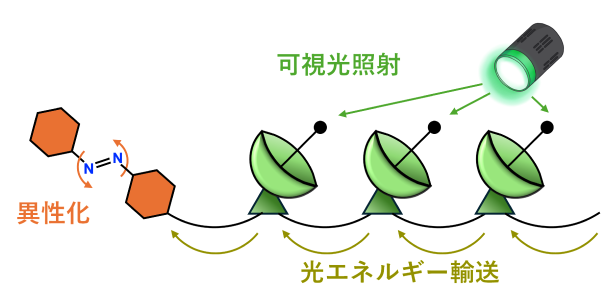
図1. 分子アンテナによるアゾベンゼンの高感度スイッチングの模式図
<関連情報>
- https://www.tohoku.ac.jp/japanese/2026/08/press20260820-01-antenna.html
- https://pubs.acs.org/jacsat/article/doi/10.1021/jacs.6c12118/5275856/Molecular-Antennae-Enhance-Visible-Light
分子アンテナによりアゾベンゼン光スイッチの可視光感度が向上する Molecular Antennae Enhance Visible-Light Sensitivity of Azobenzene Photoswitches
Yuta Chiba;Rio Shoji;Mira Kim;Shinya Takaishi;Ryota Sakamoto;Shirin Faraji;Ryojun Toyoda
Journal of the American Chemical Society August 19, 2026
DOI:https://doi.org/10.1021/jacs.6c12118
Abstract
Molecular photoswitches, which convert light energy into molecular motion, have been applied to a wide range of functional materials and biomolecules, offering precise external control. In pursuit of enhanced photosensitivity, various molecular photoswitches have been developed to increase their photoisomerization quantum yields (PIQY, Φ). However, not only PIQY but also the molar absorption coefficient (ε) for utilizing more photons is essential to achieve high photosensitivity. Here, we synthesized an azobenzene photoswitch featuring BODIPY as a molecular antenna (AzoB). Unlike the conventional azobenzene-dye hybrid, the increased ε value achieved the enhancement of photosensitivity upon 505 nm irradiation. Quantum mechanical calculations revealed a nonradiative deactivation pathway that accounts for the weak photoluminescence of the BODIPY unit in AzoB. Excited-state minima and conical intersections governing the photoisomerization dynamics suggest a more efficient isomerization process compared to azobenzene, leading to enhanced response to low-energy light and suppressed photoluminescence. Furthermore, by replacing the BODIPY antenna with dipyrrin-zinc nanochains, a significant increase in ε was achieved as the nanochain was elongated, while the efficient exciton transfer in the nanochain antennae prevented PIQY deterioration. The εΦ value reached 8.1 × 10³ M–1 cm–1 for the decanuclear nanochain, leading to the top class of photosensitivity for azobenzene actuation. These findings demonstrate the rational design strategy for molecular antennae and broaden the scope of sensitive molecular photoswitches.