2026-08-19 東北大学
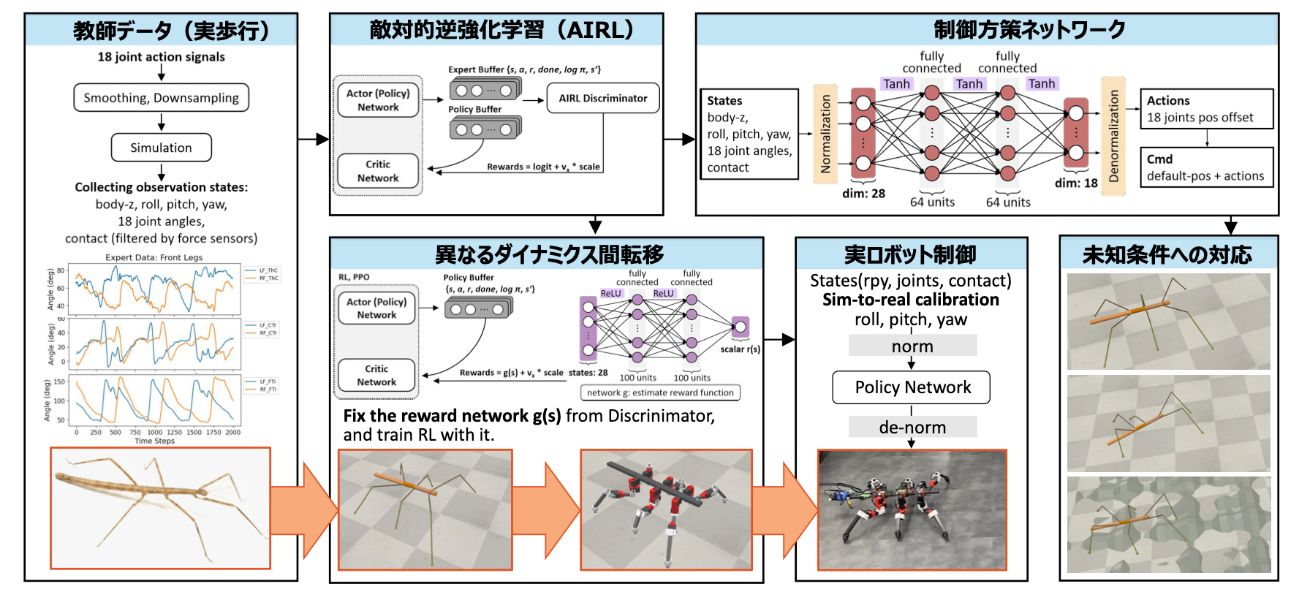
図1. ナナフシの歩行データから移植可能な歩行制御則を学習する枠組み
<関連情報>
- https://www.tohoku.ac.jp/japanese/2026/08/press20260819-04-locomotion.html
- https://iopscience.iop.org/article/10.1088/1748-3190/ae901f
昆虫の行動から応用可能なロボットの移動まで:敵対的逆強化学習による限られたデータからの身体化された移動原理の推論 From insect behavior to transferable robot locomotion: inferring embodied locomotor principles from limited data via adversarial inverse reinforcement learning
Yuchen Wang, Thirawat Chuthong, Mitsuhiro Hayashibe, Poramate Manoonpong and Dai Owaki
Bioinspiration & Biomimetics Published: 11 August 2026
DOI:10.1088/1748-3190/ae901f
Abstract
Insect locomotion exhibits remarkable adaptability and flexibility despite the limited scale of its nervous system. However, the underlying principles that govern leg coordination remain difficult to extract and model computationally. Understanding how insects achieve stable and adaptive locomotion has long provided important inspiration for the development of control strategies in bio-inspired robotics. Nevertheless, many existing approaches rely on predefined coordination rules, manually tuned parameters, or hand-crafted reward functions, which limit the flexibility and transferability of the resulting control strategies. To address this limitation, this study proposes a data-driven framework based on adversarial inverse reinforcement learning , which directly learns continuous locomotion control policies from stick insect walking data and infers latent reward structures and control strategies from biological behavioral demonstrations. Experimental results show that even when trained using only a short segment of flat-terrain demonstration data, the learned policy can still be extracted to learn adaptive and flexible leg coordination patterns under different environmental conditions. Furthermore, the learned reward network can be transferred across different dynamic systems to guide policy learning for robot models with different morphologies. Compared with methods relying solely on reward shaping, the proposed approach achieves faster convergence and produces more biologically consistent gait coordination. A preliminary deployment on a physical bio-inspired robot further demonstrates the potential of the learned policy for sim-to-real application. The proposed method provides a transferable data-driven framework for extracting and learning locomotion control strategies from biological behavior, with potential applications to bio-inspired robotic systems.