
2026-08-05 スタンフォード大学
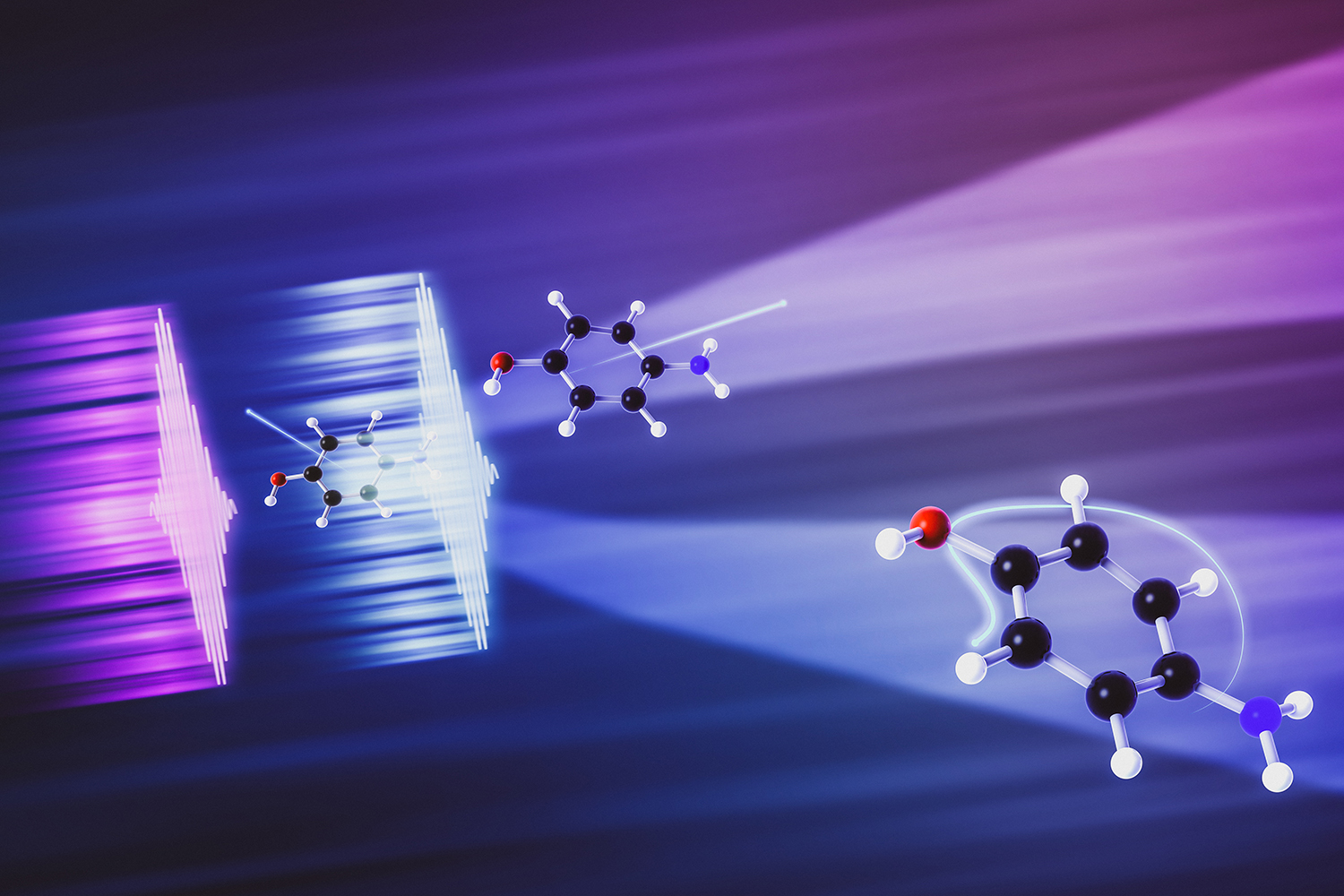
An illustration of a molecule’s electrons in motion. | Greg Stewart / SLAC National Accelerator Laboratory
<関連情報>
- https://news.stanford.edu/stories/2026/08/movie-first-steps-chemical-reaction
- https://www.nature.com/articles/s41567-026-03360-x
分子の瞬間的なイオン化に対するアト秒応答 Attosecond response of molecules to impulsive ionization
Taran Driver,Zhaoheng Guo,Erik Isele,Gilbert Grell,Marco Ruberti,Jordan T. O’Neal,Oliver Alexander,Sandra Beauvarlet,David Cesar,Joseph Duris,Douglas Garratt,Kirk A. Larsen,Siqi Li,Přemysl Kolorenč,Gregory A. McCracken,Daniel Tuthill,Zifan Wang,Nora Berrah,Christoph Bostedt,Kurtis Borne,Xinxin Cheng,Louis F. DiMauro,Gilles Doumy,Paris L. Franz,… James P. Cryan
Nature Physics Published:20 July 2026
DOI:https://doi.org/10.1038/s41567-026-03360-x
Abstract
When matter interacts with energetic radiation it can undergo sudden, or impulsive, ionization. This process can drive chemical change and occurs widely in space and planetary atmospheres, yet its comprehensive description challenges our current theoretical and computational capabilities as it requires advanced treatment of electron correlation and nonadiabatic dynamics beyond the Born–Oppenheimer approximation. Here we measure the response of the para-aminophenol molecule to sudden ionization. Using attosecond X-ray absorption spectroscopy, we resolve the ultrafast dynamics of the ionized molecule with atomic precision. A subfemtosecond decay corresponds to states undergoing non-radiative decay, whereas few-femtosecond oscillatory signatures are associated with electronic wavepacket motion in stable cation states that later couple to nuclear motion. We compare our measurement with state-of-the-art computational modelling, qualitatively reproducing the observed response across multiple timescales. These results provide a benchmark for computational models of sudden ionization and ultrafast charge motion in matter.

