2026-08-07 京都大学
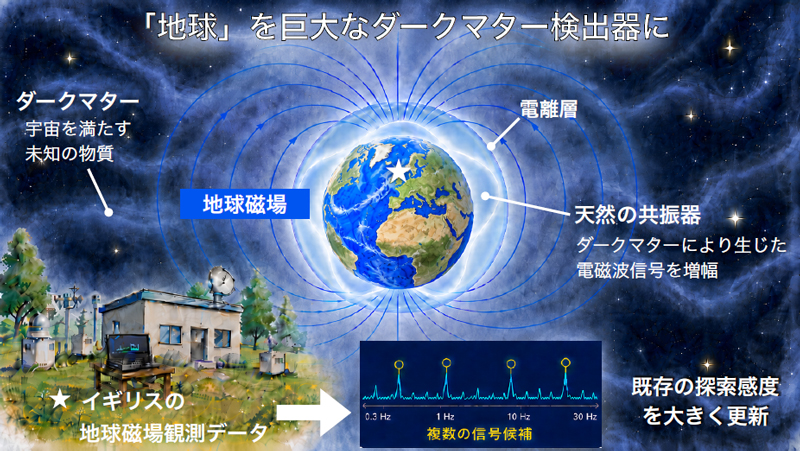
地球磁場データを用いたダークマター探索の概念図
(Open AI ChatGPT(GPT-5.5 Thinking)をもとに姫本・樽家が作成)
<関連情報>
- https://www.kyoto-u.ac.jp/ja/research-news/2026-08-07-1
- https://academic.oup.com/ptep/article/2026/7/073B06/8691578
- https://academic.oup.com/ptep/article/2026/7/073E02/8704104
- https://journals.aps.org/prd/abstract/10.1103/kw4j-8v12
- https://academic.oup.com/ptep/article/2025/11/111E01/8266541?login=false
低周波地球電磁場におけるアクシオン・ダークマターのシグネチャー:定式化と理論予測 Signature of Axion Dark Matter in Low-Frequency Terrestrial Electromagnetic Fields: Formulation and Predictions
Atsushi Taruya,Atsushi Nishizawa,Yoshiaki Himemoto
Progress of Theoretical and Experimental Physics Published:23 May 2026
DOI:https://doi.org/10.1093/ptep/ptag097
Abstract
We develop a theoretical framework for axion dark matter searches using terrestrial electromagnetic (EM) fields, enabling a global and quantitative characterization of the signal across the Earth. Axions couple to the geomagnetic field and generate a monochromatic EM signal at a frequency set by the axion mass. Incorporating a realistic atmospheric conductivity, we describe the axion-induced EM waves confined in the Earth–ionosphere cavity, avoiding the divergences present in idealized treatments. Our semi-analytical method yields quantitative predictions for the axion-induced magnetic field near the Earth’s surface, and we found that (i) at ma≳10-14 eV, the signal exhibits resonance structures aligned with Schumann resonances, and the magnetic field amplitude is especially enhanced at ma~3×10-14 eV. (ii) The signal amplitude and orientation also vary with geographic location, with Southeast Asia offering the strongest sensitivity. These predictions are insensitive to uncertainties in conductivity models and boundary conditions. Those distinctive features provide a reliable template to distinguish axion-induced signals from natural or anthropogenic EM backgrounds, and the formalism can be extended to other DM candidates such as dark photons.
極低周波地球磁場を用いたアクシオン・ダークマター探索 Axion Dark Matter Search from Terrestrial Magnetic Fields at Extremely Low Frequencies
Atsushi Nishizawa,Atsushi Taruya,Yoshiaki Himemoto
Progress of Theoretical and Experimental Physics Published:08 June 2026
DOI:https://doi.org/10.1093/ptep/ptag108
Abstract
The natural environment of the Earth can act as a sensitive detector for dark matter in ultralight axions. When axions with masses in the range of 10-15–10-13eV pass through the Earth, they interact with the global geomagnetic field, generating electromagnetic (EM) waves in the extremely low-frequency range of deci-hertz to several hertz through axion–photon coupling. This paper is one of a series of companion papers for [A. Taruya, A. Nishizawa, and Y. Himemoto, Prog. Theor. Exp. Phys. 2025, 111E01 (2025).] that focus on the data analysis method and the search results for an axion signal. Utilizing the theoretical predictions of axion-induced EM spectra from a companion study, we analyzed the long-term observational data of terrestrial magnetic fields in this frequency band to search for axion-induced signals. Our analysis identified 65 persistent signal candidates with a signal-to-noise ratio greater than 3. Aside from these candidates, we placed a new upper bound on the axion–photon coupling parameter, significantly refining the previous constraint from CAST by at most two orders of magnitude down to gaγ≲ 4×10–13 GeV for an axion mass of about 3×10-14 eV.
地球磁場を用いたダークフォトン・ダークマターの探索 Searching for dark photon dark matter from terrestrial magnetic fields
Kimihiro Nomura, Atsushi Nishizawa, Atsushi Taruya, and Yoshiaki Himemoto
Physical Review D Published: 11 May, 2026
DOI: https://doi.org/10.1103/kw4j-8v12
Abstract
We present a novel search for dark photon dark matter (DM) using terrestrial magnetic field measurements at frequencies below 100 Hz. Coherently oscillating dark photon DM can induce a monochromatic magnetic field via kinetic mixing with ordinary photons. Notably, for dark photon masses ′ around 3 ×10⁻¹⁴ eV, the signal can be resonantly amplified within a cavity formed by the Earth’s surface and the ionosphere. We compute the expected signal incorporating the effect of atmospheric conductivity, and derive new upper limits on the kinetic mixing parameter from long-term geomagnetic data. These limits improve upon previous ground-based constraints in the mass range of 1 ×10⁻¹⁵ eV ≲′ ≲2 ×10⁻¹³ eV.
低周波地球磁場にひそむアクシオン・ダークマターのシグネチャーの探索 Hunting Axion Dark Matter Signatures in Low-Frequency Terrestrial Magnetic Fields
Atsushi Taruya,Atsushi Nishizawa,Yoshiaki Himemoto
Progress of Theoretical and Experimental Physics Published:26 September 2025
DOI:https://doi.org/10.1093/ptep/ptaf136
Abstract
We show that Earth’s natural environment can serve as a powerful probe for ultralight axion dark matter. In the presence of global geomagnetic fields, axions with masses ranging from 10–15eV– 10–13eV induce electromagnetic waves in the (sub-) extremely low-frequency band (0.3–30 Hz) through axion–photon coupling. We predict the amplitude of induced magnetic fields in the Earth–ionosphere cavity, taking the finite conductivity of the atmosphere into account. This allows us to constrain the axion–photon coupling parameter,gaγ , from the long-term monitoring data of the low-frequency magnetic fields, resulting in a significant improvement from the previous constraints down to gaγ≲ 4×10–13GeV-1 for axion mass ∼3×10-14 eV .