2026-08-06 神戸大学
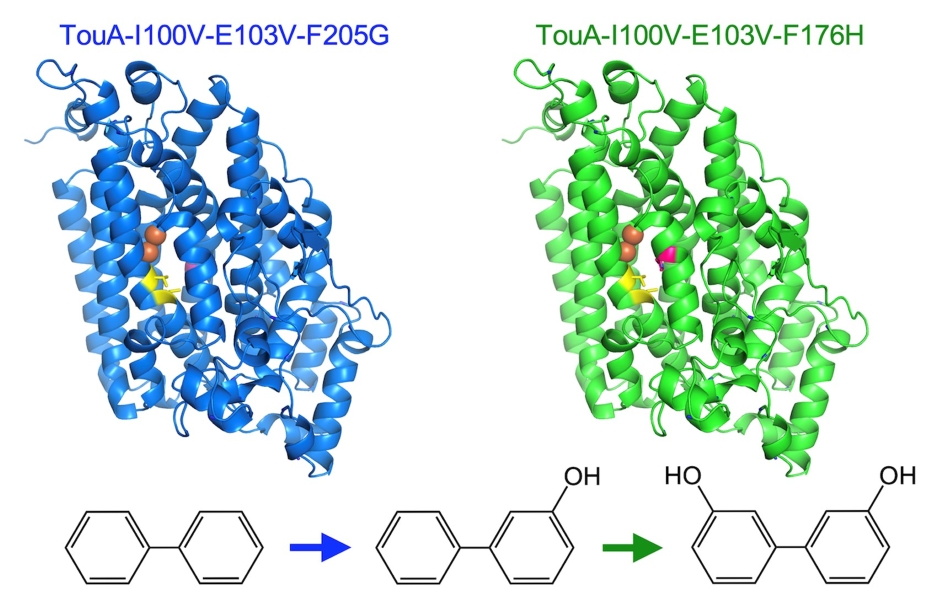
ToMOの触媒サブユニットTouAに変異を導入した2種類の酵素、I100V–E103V–F205G変異体とI100V–E103V–F176H変異体の3次元構造モデルを示しています。
© VAVRICKA Christopher J., ACS Catalysis, 2026(DOI:10.1021/acscatal.6c03624)(CC-BY-NC-ND)
<関連情報>
- https://www.kobe-u.ac.jp/ja/news/article/20260806-68176/
- https://pubs.acs.org/accacs/article/doi/10.1021/acscatal.6c03624/5246155/Engineering-a-Highly-meta-Selective-Biphenyl
高付加価値ポリマー前駆体の生合成のための、 高度にメタ選択的なビフェニルモノオキシゲナーゼ の設計 Engineering a Highly meta-Selective Biphenyl Monooxygenase for the Biosynthesis of High-Value Polymer Precursors
Christopher J. Vavricka ;Takeshi Matsui ;Satoshi Yuzawa;Hiroto Ida;Ryota Hidese;Akihiko Kondo;Tomohisa Hasunuma
ACS Catalysis Published:August 05, 2026
DOI:https://doi.org/10.1021/acscatal.6c03624
Abstract
The meta-selective C–H functionalization of aromatic substrates lacking meta-directing electron-withdrawing groups remains challenging. To engineer the regioselective enzymatic conversion of biphenyl (BP) to 3,3′-dihydroxybiphenyl (33DHBP), an industrial precursor to high-performance polymers, substrate positioning within the active site must be precisely controlled. Here, we report the regioselective catalytic promiscuity engineering of toluene/o-xylene monooxygenase (ToMO) to achieve sequential, meta-selective hydroxylation of the non-natural biaryl BP, where distinct ToMO variants were engineered to catalyze meta-selective hydroxylation of BP, 3-hydroxybiphenyl (3HBP), or both. Variants to catalyze the meta-selective hydroxylation of BP were designed using an automated docking workflow, with predicted binding poses consistent with the observed regioselectivity; this resulted in the development of the I100V-E103V-F205G variant that hydroxylated BP with 100% apparent meta-selectivity. Additional substitutions, especially L268A and L402A, were introduced to widen the long hydrophobic active-site access channel, further improving meta-selective BP hydroxylation in Pseudomonas putida. Variants to catalyze the meta-selective hydroxylation of 3HBP were selected through a structure-based residue scan of 437 active-site substitutions, resulting in the identification of the I100V-E103V-F176H variant that hydroxylated 3HBP with over 90% apparent meta-selectivity and no activity toward BP. In addition, the combined I100V-E103V-I162Y-F205G variant hydroxylated 3HBP with over 90% apparent meta-selectivity and improved hydroxylation of BP. This study demonstrates structural and computational monooxygenase engineering for the regioselective hydroxylation of non-natural biaryls, enabling the production of 33DHBP as a valuable precursor to specialized polymers.