2026-08-06 米国国立標準技術研究所(NIST)
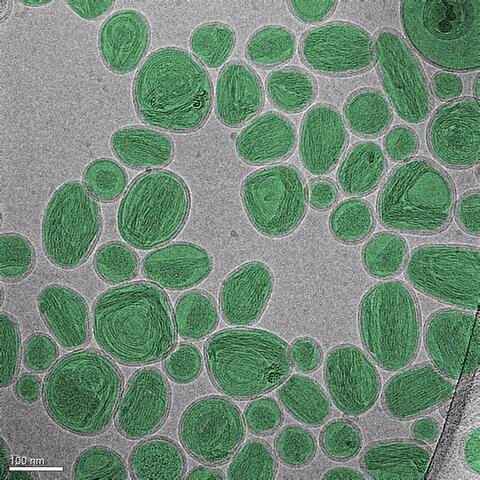
A colorized electron microscope image shows lipid nanoparticles containing a cancer drug. The amount of drug contained depends on the size of each nanoparticle. NIST researchers have developed a new analysis to better understand how the useful properties of nanoparticles depend on their size — in this example, to optimize drug delivery to cancer patients. The new analysis can also find use in other products that use nanoparticles and other nanomaterials, including electronics, ceramics and coatings. Credit: Dr. Pierre-Alain Burnouf/Shutterstock, Natasha Hanacek/NIST
<関連情報>
- https://www.nist.gov/news-events/news/2026/08/nist-researchers-correct-common-error-confounding-nanotech-measurements
- https://pubs.acs.org/ancac3/article/doi/10.1021/acsnano.5c12141/5247215/Measurement-Error-Models-Enable-Accurate
測定誤差モデルにより、ナノスケール特性と構造の正確な相関関係が実現する Measurement Error Models Enable Accurate Correlation of Nanoscale Properties and Structures
Adam L. Pintar;Andrew C. Madison;Craig R. Copeland;Natalia Farkas;Samuel M. Stavis
ACS Nano Published:August 06, 2026
DOI:https://doi.org/10.1021/acsnano.5c12141
Abstract
Measurement errors can catastrophically bias parameter estimates in models to correlate nanoscale properties and structures, undercutting a foundation of nanoscience and nanotechnology. In a general solution to this latent problem, we derive a method-of-moments correction for least-squares estimates of correlative model parameters. Our correction applies to many relations of dependent and independent variables, subject to many types of measurement errors of the independent variable. Focusing on the prevalent power-law model to correlate optical intensity and nanoparticle size, we test the limits of accuracy of our correction and study the use of either reference size distributions or sizing uncertainty estimates to inform a measurement error model. We critically evaluate representative measurements of various nanoparticles, impacting the conclusions of several studies and changing expectations of intensity scaling exponents for nanoscale optical inferences. Our correction is immediately available, highly interpretable, and broadly applicable to gain reliable insights and prevent future mistakes.