2026-07-31 東京科学大学
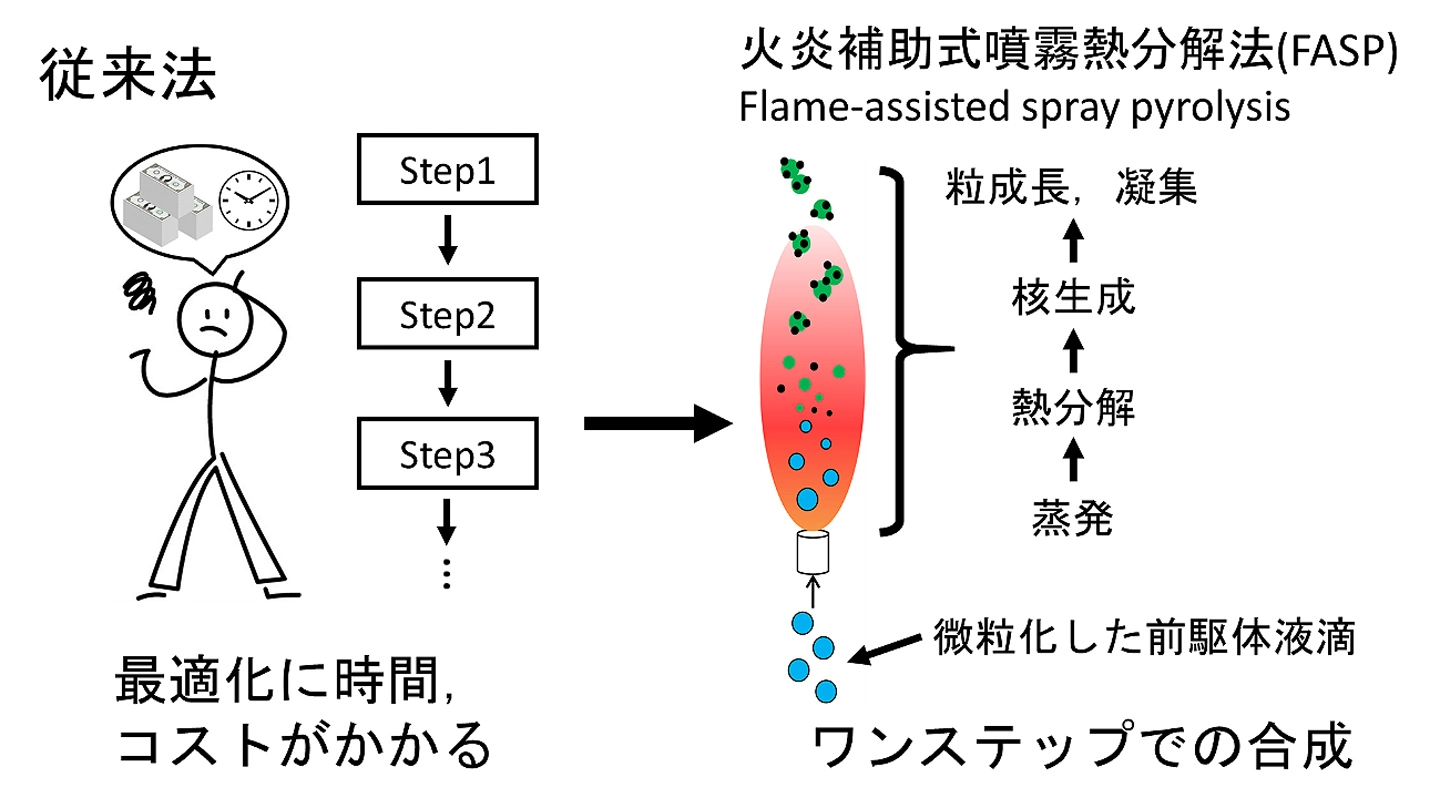
図1. 従来法と火炎補助式噴霧熱分解法(FASP)の比較
<関連情報>
- https://www.isct.ac.jp/ja/news/jh1qiyq5zt1q
- https://www.sciencedirect.com/science/article/pii/S0016236126023185
火炎補助噴霧熱分解法によるCO₂メタン化用微細構造Ni/CeO₂触媒の一段階合成 One-step synthesis of Ni/CeO2 catalyst with fine structure for CO2 methanation by flame-assisted spray pyrolysis
Kosei Okada, Tsuyoshi Nagasawa, Hiroki Yamada, Toshiaki Ina, Maki Nakamura
Fuel Available online: 8 July 2026
DOI:https://doi.org/10.1016/j.fuel.2026.140563
Highlights
- Ni/CeO2 catalysts are made by flame-assisted spray pyrolysis (FASP) in one-step.
- FASP-made catalyst is primarily composed of fine particles measuring 10–20 nm.
- FASP improves specific surface area and Ni dispersion than impregnation method.
- Small NiO clusters in FASP-catalysts provide abundant Ni-CeO2 interfacial sites.
- FASP-made catalyst shows superior CO2 methanation activity at 300–400℃.
Abstract
CO2 methanation is attracting attention as a synthetic fuel manufacturing process using hydrogen from renewable energy. The large-scale implementation of methanation in society requires the development of high-performance, stable catalysts and the establishment of methods for their mass production. In this study, Ni/CeO2 catalyst is prepared using flame-assisted spray pyrolysis (FASP), which is a one-step and rapid process for producing fine particles, and the detailed particle structure and CO2 methanation performance are evaluated. The results are also compared with those of catalysts prepared by the conventional impregnation method (IM). The FASP catalyst consists mainly of particles ranging from 10–20 nm in size, with some particles reaching several hundred nanometers, while IM catalyst consists of micrometer-sized CeO2 particles with approximately 30 nm-Ni particles on the surface. The FASP catalyst also shows higher specific surface area and Ni dispersion than the IM catalyst. Furthermore, XAFS, XPS, and H2-TPR analyses suggests that FASP promotes the formation of oxygen vacancies, Ni-O-Ce interfacial sites, and reduced Ni species. In CO2 methanation tests, the FASP catalyst exhibits higher CO2 conversion and CH4 selectivity than the IM catalyst, achieving a CH4 production rate of 81.3 µmol/(gcat·s) at 300 °C, which is high-level among the literature values. These suggest that the fine particle structure, abundant oxygen vacancies and reduced Ni species, and increased Ni-CeO2 interfaces formed by FASP contribute to the enhanced catalytic activity. This study demonstrates that FASP is a promising method for the simple production of highly active CO2 methanation catalysts with fine structure.