2026-07-29 東京大学
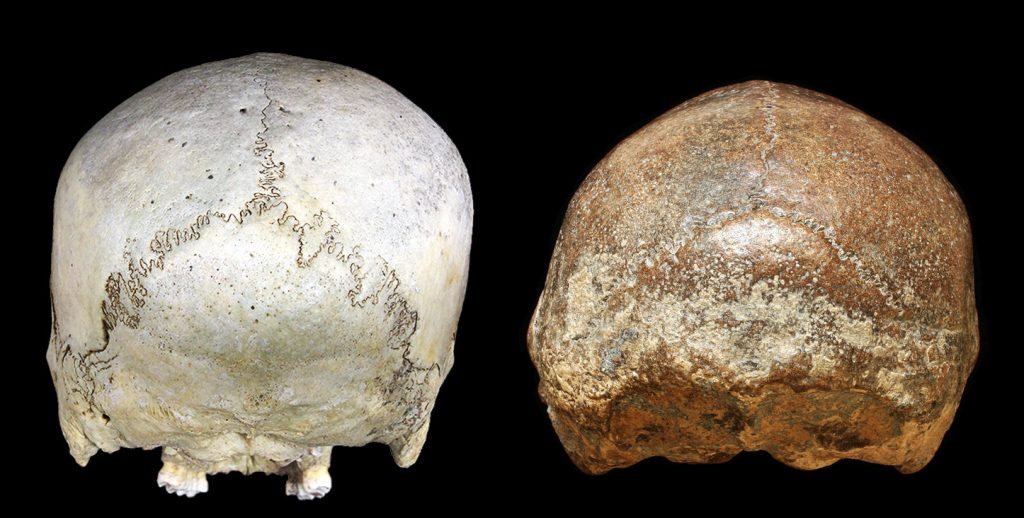
横方向への強い歪みを示す現代人(左)とジャワ原人(右)の頭骨。
どちらも後ろからみたところ。
<関連情報>
- https://www.um.u-tokyo.ac.jp/research/umutnews/umutnews20260729.html
- https://royalsocietypublishing.org/rspb/article/293/2075/20261055/482651/Cranial-evidence-for-human-like-helpless-infancy?searchresult=1
ホモ・エレクトスとホモ・フロレシエンシス における、ヒトのような無力な乳児期を示す頭蓋骨の証拠 Cranial evidence for human-like helpless infancy in Homo erectus and Homo floresiensis
Yousuke Kaifu;Wataru Yano;Makoto Hikosaka;Daisuke Shimizu;Takeshi Nishimura;Daisuke Kubo;Rusyad Adi Suriyanto;Jatmiko;Thomas Sutikna;Naoki Morimoto;Iwan Kurniawan
Proceedings of the Royal Society B Published:29 Jul 2026
DOI:https://doi.org/10.1098/rspb.2026.1055
Abstract
Unlike other catarrhine primates, modern humans deliver a helpless newborn who requires prolonged extensive care. Such helpless infancy is associated with fetus-like, rapid postnatal brain growth, which is essential to produce the large human brain. In the debate about its evolution, a key question has been whether it emerged in Homo erectus, whose brain sizes were approximately 20–40% smaller than Homo sapiens. We here show that a type of asymmetric cranial deformity called deformational plagiocephaly can serve as a direct indicator of helpless infancy, regardless of the developmental age of the fossil specimens in question. Because clinical studies have established that such deformation results primarily from an immature state of cranial bones and neck/body muscles, deformational plagiocephaly (or at least its marked condition) must be unique to humans among extant hominids (or more broadly catarrhine primates). Our metric examination based on 1504 cranial specimens (996 great apes and 508 modern humans) supports this working hypothesis. We have found that some cranial fossils of Indonesian H. erectus and Homo floresiensis also display such deformities. These support a deep evolutionary origin of hominin helpless infancy, and imply both elaborate parental childcare and cooperative social behaviours that could likely have accompanied it.