2026-07-28 東京科学大学
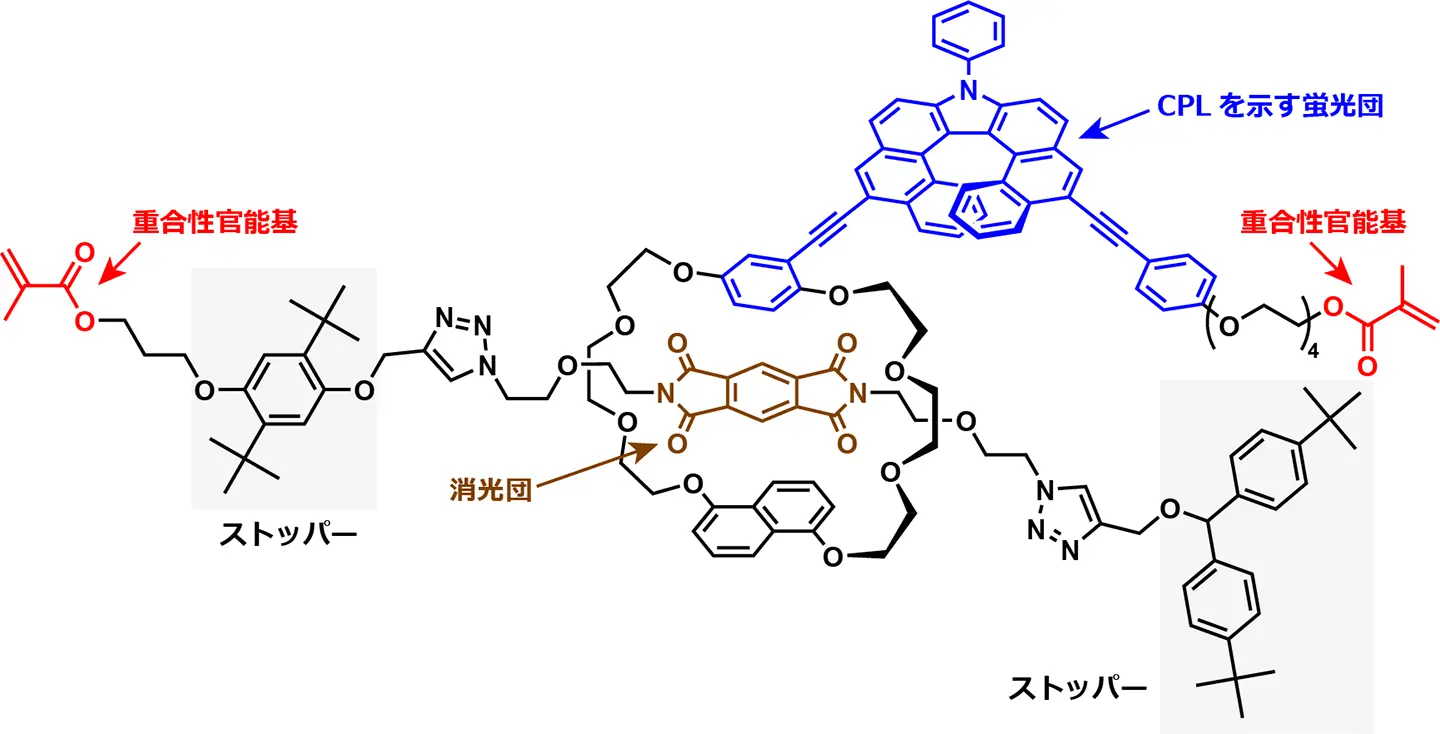
図1. 本研究で開発したロタキサン型超分子メカノフォアの分子構造。
<関連情報>
- https://www.isct.ac.jp/ja/news/dqikdgr8jisx
- https://onlinelibrary.wiley.com/doi/10.1002/anie.9590374
ロタキサン構造を用いた円偏光発光の力誘起制御 Force-Induced Control of Circularly Polarized Luminescence With Rotaxane Architecture
Keigo Nonaka, Takumi Kuroda, Kota Masuda, Toshiki Nishitani, Masaki Enokido, Makoto Tsurui, Yuichi Kitagawa, Yasuchika Hasegawa, Keiichi Noguchi, Koji Nakano, Yoshimitsu Sagara
Angewandte Chemie International Edition Published: 24 July 2026
DOI:https://doi.org/10.1002/anie.9590374
ABSTRACT
The reversible molecular motions of mechanically interlocked molecules (MIMs) have played a crucial role in realizing stimuli-responsive functions. While the reversible switching of circularly polarized luminescence (CPL) properties has been achieved using MIMs through pH change and/or addition of chemicals, the mechanically controlled CPL utilizing the interlocked architecture has not yet been demonstrated. Here, we introduce a rotaxane-based mechanophore designed for force-induced CPL on/off switching. The mechanophore consists of a ring featuring a CPL-active helicene luminophore and an axle with a matching quencher. The rotaxane mechanophores covalently introduced at the cross-linking points of a double-network (DN) gel are reversibly activated and deactivated in response to changes in applied force transduced through the polymer chains during the macroscopic swelling and shrinking of the DN gel. The isotropic swelling of the DN gel effectively suppresses artifacts arising from macroscopic sample orientation, enabling accurate detection of reciprocal CPL derived from a single chiral emitter. This work establishes the first example of mechanical control of CPL at the single-molecule level and provides a robust measurement methodology for force-induced CPL switching in soft materials.