2026-07-28 シンガポール国立大学(NUS)
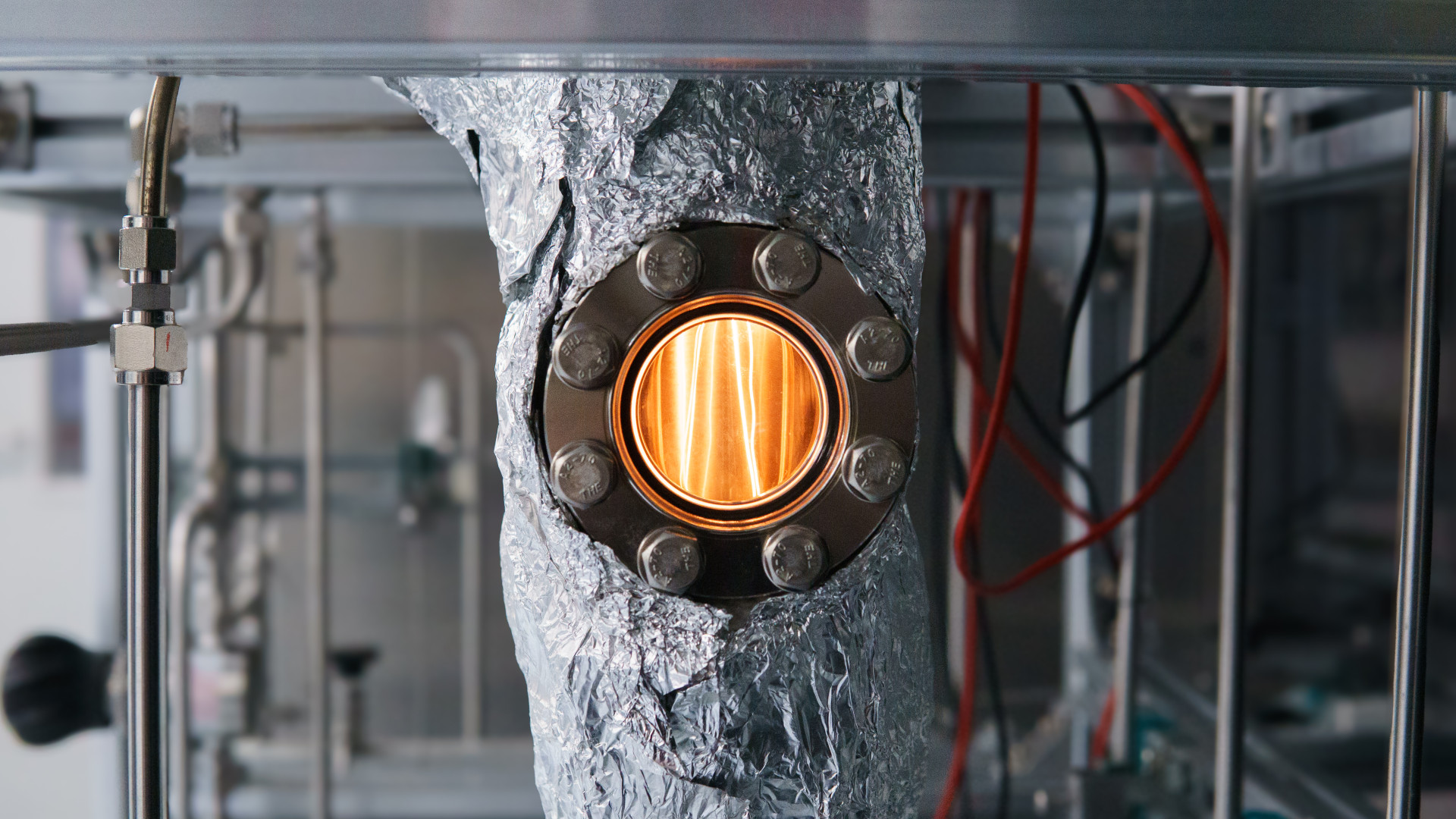
A close-up of the lightbulb-inspired reactor, in which electricity heats a thin metal filament to generate the high temperatures needed for some important chemical reactions.
<関連情報>
- https://news.nus.edu.sg/lightbulb-reactor-tackles-decarbonisation-challenges/
- https://www.nature.com/articles/s41893-026-01812-z
- https://www.nature.com/articles/s41467-025-65524-2
- https://www.nature.com/articles/s44286-025-00283-x
効率的なメタン変換のためのフィラメント触媒電球型反応器 Filament-catalyst lightbulb reactor for efficient methane conversion
Ji Yang Tan,Sikai Wang,Abhinandan Nabera,Keshia Saradima Indriadi,Sie Shing Wong,Gonzalo Guillén-Gosálbez,Javier Pérez-Ramírez & Ning Yan
Nature Sustainability Published:22 April 2026
DOI:https://doi.org/10.1038/s41893-026-01812-z
Abstract
Direct non-oxidative conversion of abundant methane provides a sustainable route to valuable ethylene and aromatics, avoiding carbon dioxide formation and minimizing intermediate steps, which can improve carbon efficiency. However, due to the high chemical stability of methane, this process is fundamentally constrained by the tradeoff between conversion and selectivity under isothermal conditions. Here we overcome this challenge by using a non-isothermal filament catalyst lightbulb reactor that spatially separates methane activation and selectivity tuning. A joule-heated molybdenum filament reaches 1,000–1,457 °C to activate methane, whereas a palladium (Pd) based catalyst layer coated in the reactor inner shell operates at much lower temperature (154–350 °C) to promote selective hydrocarbon transformation. This decoupling enables high methane conversion in the high-temperature zone, while facilitating controlled aromatization and hydrogenation of reactive intermediates over Pd catalyst in the low-temperature zone, achieving nearly 40% yield of ethylene and benzene, toluene and xylene, with 62% hydrogen yield. Coking—the parasitic buildup of solid carbon deposits on the surfaces within chemical reactors—occurs only on the filament surface, remaining minimal and regenerable. Techno-economic and life cycle analyses indicate strong potential for economically competitive production of value-added chemicals from methane with net-zero emissions using this reactor concept.
電球に着想を得た、高モノマー選択性を有するポリオレフィン系プラスチックの高温触媒解重合 Light bulb-inspired high-temperature catalytic depolymerization of polyolefin plastic with high monomer selectivity
Shijie Yu,Peijie Han,Haoyue Li,Sikai Wang,Junyang Xuan & Ning Yan
Nature Communications Published:25 November 2025
DOI:https://doi.org/10.1038/s41467-025-65524-2
Abstract
The accumulation of plastic waste poses a severe environmental issue, and efficient depolymerization of plastic is essential toward sustainable waste management and circularity. However, depolymerizing polyolefin plastic into monomer with high selectivity remains a challenge. Herein, inspired by the incandescent light bulb, we demonstrate a catalytic depolymerization strategy utilizing high-temperature transition metal filaments to convert polyolefin plastic to olefin monomer, with monomer selectivity reaching up to 65%. The electrified transition metal filaments, serving as localized heat sources, can reach a high temperature of up to 2300 °C, significantly promoting the generation of gaseous products. The reaction region with sharp temperature gradient restrains secondary transformations of monomer. Monomer selectivity is tunable by varying different high-melting-point metallic elements, and can be extended to bulk commodity alloy, such as stainless steel.
電気を通したタングステン線電球型反応器を用いた超高速アンモニア分解 Ultrafast ammonia decomposition using an electrified tungsten wire lightbulb reactor
Keshia Saradima Indriadi,Sie Shing Wong,Peijie Han,Sikai Wang,Di Xu & Ning Yan
Nature Chemical Engineering Published:21 October 2025
DOI:https://doi.org/10.1038/s44286-025-00283-x
Abstract
Ammonia decomposition is a key reaction in the green hydrogen economy because ammonia is an important carbon-free hydrogen carrier. In contrast to the prevalent focus on developing active catalysts to address the reaction’s slow kinetics at low temperatures, we introduce a tungsten wire lightbulb reactor that operates at unconventionally locally high temperatures while maintaining enhanced efficiency. Near the wire, the local temperature reaches up to 1,800 K, enabling ultrafast ammonia decomposition with rate constants much higher than those of leading catalysts under typical reaction conditions. Concurrently, the sharp temperature decrease along the radial direction allows for low power input, thus enhancing energy efficiency. The lightbulb reactor also realized up to 99.995% conversion at enhanced power input without the use of additional separation steps. We further propose a scaled-up reactor design that is two to three orders of magnitude smaller than current state-of-the-art reactors and highlight its potential applications within the emerging hydrogen economy.