2026-07-15 中国科学院(CAS)
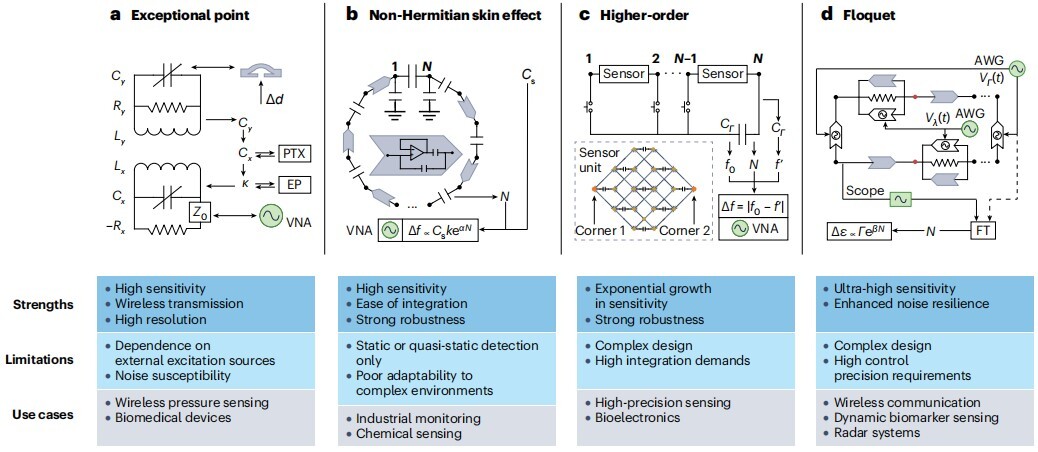
Topolectrical sensor architectures and performance. (Image by AIRCAS)
<関連情報>
- https://english.cas.cn/newsroom/research-news/202607/t20260720_1178695.shtml
- https://www.nature.com/articles/s44287-026-00308-4
電気回路工学 Engineering topolectrical circuits
Yuxin Jiang,Wenhao Li,Weixuan Zhang,Ce Shang,Yihao Yang,Xiangdong Zhang,Ching Hua Lee & Ronny Thomale
Nature Reviews Electrical Engineering Published:02 July 2026
DOI:https://doi.org/10.1038/s44287-026-00308-4
Abstract
Topolectrical circuits are electrical networks that encode topological band theory. Their physical behaviour is set by how the components are wired together, not by where they are placed. This wiring-centred design delivers defect tolerance, directional signal flow without bulky magnetic parts, and amplified response at boundaries. Conventional electronics obtain these only by adding isolators, feedback or calibration after the circuit is laid out. In this Review, we identify which capabilities are engineering-ready and which remain confined to the laboratory. We cover the underlying physics, the resulting sensors and engineering applications, and cross-disciplinary uses in quantum simulation, artificial intelligence-assisted design and curved-space geometries. We then examine how co-integration with memristive devices makes the platform adaptive and history-dependent. We close with the hardware routes towards deployable electronics, from monolithic chips to flexible substrates and body-worn systems.
Key points
- Topolectrical circuits build defect tolerance and magnet-free directional signal routing directly into the wiring graph and component admittances, replacing the conventional approach of adding external isolators, feedback or calibration loops after the circuit is laid out.
- What distinguishes topolectrical hardware is that the wiring graph, component admittances and grounding (not the spatial layout of the components) control the physics, so a single reconfigurable board can be reprogrammed into different topological phases by changing the connectivity rather than fabrication.
- Programmable circuit elements unify the field’s distinct physical extensions into a single engineering toolkit, supporting boundary-localized sensing, magnet-free directional radio-frequency routing and defect-tolerant signal flow.
- Memristive co-integration extends the platform from a static circuit class into adaptive, history-dependent hardware. Cross-disciplinary use in topological quantum simulation, artificial intelligence-assisted design and curved-space geometries further establishes topolectrical circuits as a programmable testbed for problems that other platforms cannot easily host.
- The route to deployable hardware progresses from monolithic complementary metal–oxide–semiconductor (CMOS) chips through flexible and stretchable substrates and body-area networks to conformal wearable systems and robotic electronic (e)-skin co-designed with embodied artificial intelligence.