2026-04-06 ノルウェー科学技術大学(NTNU)
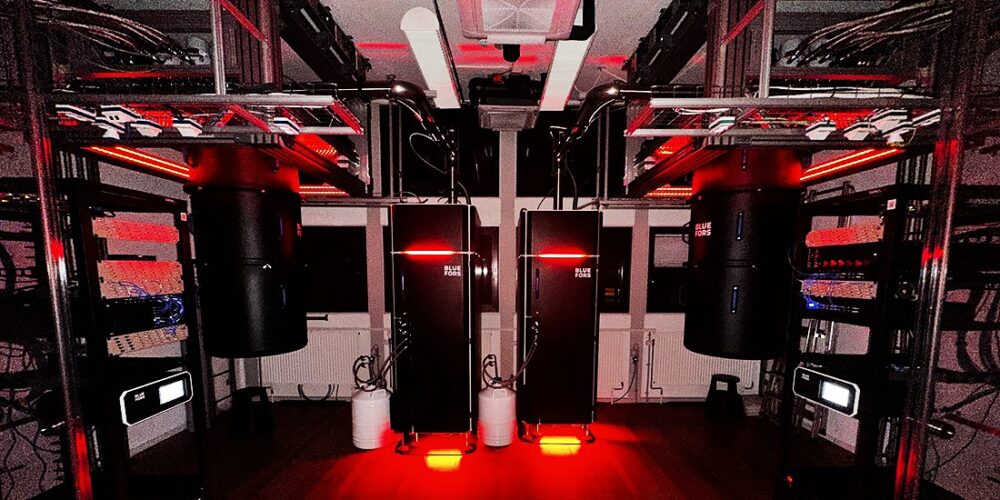
The Low Temperature Laboratory for Quantum Research at the Niels Bohr Institute. This is where the experiments were carried out. Photo: Quantum Machines
<関連情報>
- https://norwegianscitechnews.com/2026/04/helping-resolve-quantum-computers-memory-problem/
- https://journals.aps.org/prx/abstract/10.1103/gk1b-stl3
超伝導量子ビットにおける変動する緩和率のリアルタイム適応追跡 Real-Time Adaptive Tracking of Fluctuating Relaxation Rates in Superconducting Qubits
Fabrizio Berritta, Jacob Benestad, Jan A. Krzywda, Oswin Krause, Malthe A. Marciniak, Svend Krøjer, Christopher W. Warren, Emil Hogedal, Andreas Nylander et al.
Physical Review X Published: 13 February, 2026
DOI: https://doi.org/10.1103/gk1b-stl3
Abstract
The fidelity of operations on a solid-state quantum processor is fundamentally bounded by environmental decoherence. Characterizing environmental fluctuations is challenging because the acquisition time of nonadaptive experimental protocols limits temporal precision and can average out rapid features of the underlying dynamics. Here, we overcome this temporal-resolution limit by 2 orders of magnitude using a field-programmable gate-array powered classical controller that adaptively and continuously tracks the relaxation-time fluctuations of two fixed-frequency superconducting transmon qubits, which exhibit average relaxation times of approximately 0.17 ms and occasionally exceed 0.5 ms. We report events in which the relaxation time switches by nearly an order of magnitude over timescales of just tens of milliseconds, rather than minutes or hours as previously reported. Our real-time Bayesian estimation protocol estimates relaxation times within a few milliseconds, close to the decoherence timescale itself. Our statistical analysis further suggests that some of these fast fluctuations arise from two-level systems switching at rates up to 10 Hz, 4 orders of magnitude faster than earlier reports. These results redefine the timescales relevant for calibration in superconducting quantum processing units, establish a reference for rapid relaxation-rate characterization in device screening, and improve our understanding of fast relaxation dynamics.