2026-07-16 NASA
◆2025年の地球接近時、NASA深宇宙ネットワーク(DSN)のレーダー観測では予測位置に天体が現れず、詳細な天体位置観測の結果、重力だけでは説明できない軌道変化が確認された。研究チームは、氷が太陽熱で昇華してガスを放出するアウトガスによる推力が原因と推定し、ハワイのカナダ・フランス・ハワイ望遠鏡(CFHT)や欧州南天天文台(ESO)の超大型望遠鏡(VLT)などで追観測を実施した。その結果、ごく淡い尾とコマ(ガス・塵の雲)が検出され、1998 SH2が彗星であることが確認された。
◆研究は、微弱なアウトガスによる軌道のずれを精密に解析することで、「暗い彗星(ダークコメット)」のように外見は小惑星でも実際は彗星である天体を識別できることを示した。これは地球近傍天体の起源解明や惑星防衛における衝突リスク評価の精度向上にもつながる成果である。
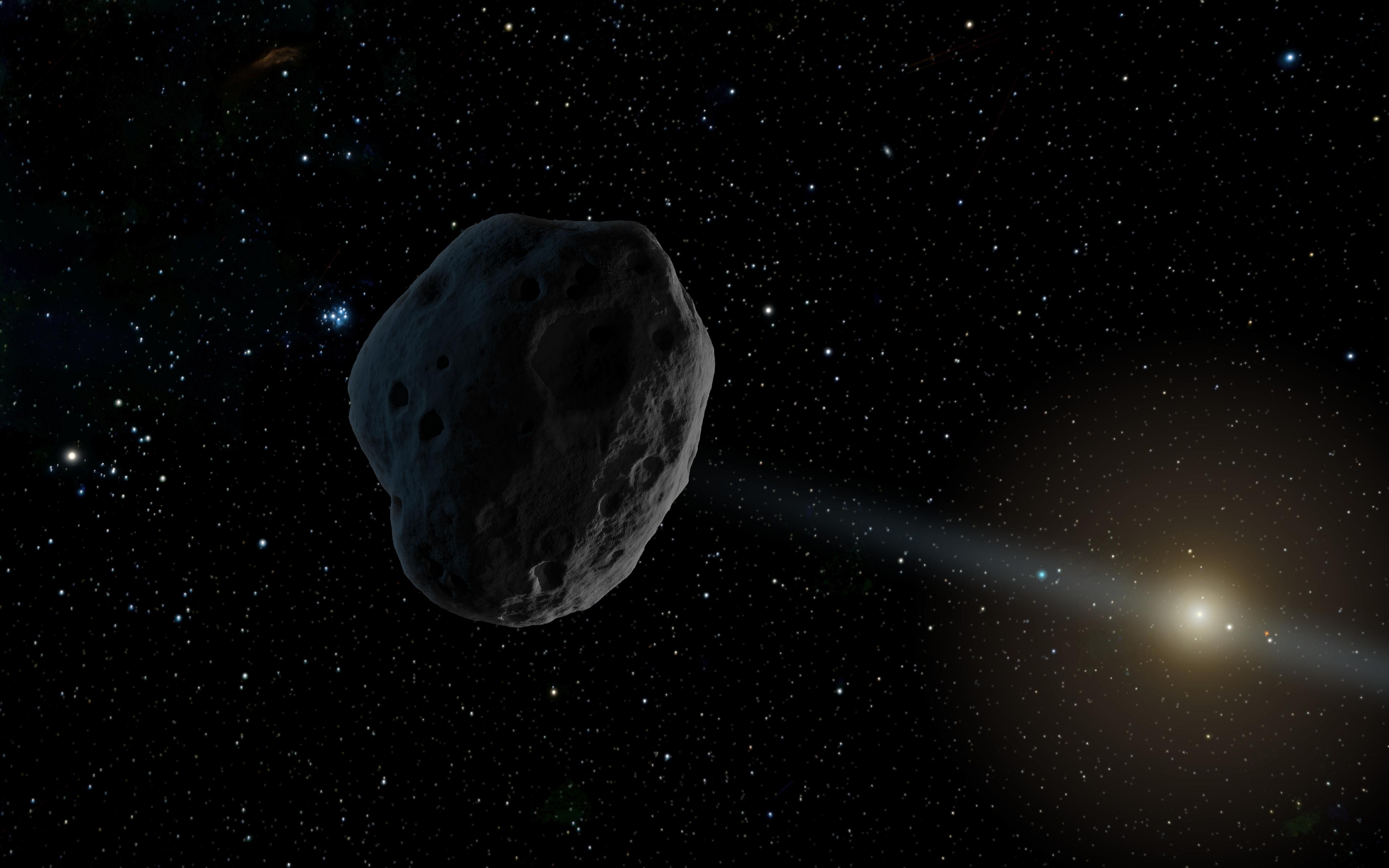
This artist’s concept depicts a near-Earth asteroid with an elongated orbit. A few objects such as these can exhibit significant perturbations in their motion around the Sun and, like the asteroid 1998 SH2, could turn out to be regular comets with a weak tail and coma (the gas and dust around a comet’s nucleus). NASA/JPL-Caltech
<関連情報>
- https://www.nasa.gov/solar-system/comets/nasa-study-finds-near-earth-asteroid-is-actually-comet/
- https://www.nature.com/articles/s41550-026-02913-7
地球近傍天体の彗星活動を示唆する非重力的な加速 Non-gravitational acceleration indicative of cometary activity of near-Earth object
D. Farnocchia,O. R. Hainaut,D. Z. Seligman,R. Weryk,L. A. M. Benner,M. Brozović,L. Denneau,A. Galád,J. D. Giorgini,K. Hornoch,M. Micheli,S. P. Naidu,R. S. Park,P. Pravec & R. J. Wainscoat
Nature Astronomy Published:10 July 2026
DOI:https://doi.org/10.1038/s41550-026-02913-7
Abstract
The activity of comets when they approach the Sun usually manifests visibly with the appearance of a dust and gas coma, and in turn non-gravitational accelerations perturbing their motion. However, there exist objects that are morphologically inactive and yet exhibit non-gravitational accelerations. Here we show that astrometry from 1998 to 2025 of near-Earth object (875163) 1998 SH2 reveals orbital perturbations consistent with cometary outgassing. Although no cometary activity was evident in archival images, large-aperture telescopic observations show a weak low-surface-brightness tail and prove that 1998 SH2 is indeed a cometary object. When cometary activity is weak, outgassing may remain undetected for decades. Our results show that non-gravitational perturbations apparent over long astrometric data arcs provide a diagnostic for identifying comets and suggest that more near-Earth objects currently classified as asteroids could in fact be comets. Therefore, our findings prompt searches to detect additional near-Earth objects exhibiting weak cometary activity. The motion of these weak comets can be more strongly perturbed than that of asteroids, influencing assessment of their Earth impact hazard and our understanding of the delivery of water to Earth.