
2026-07-10 東北大学
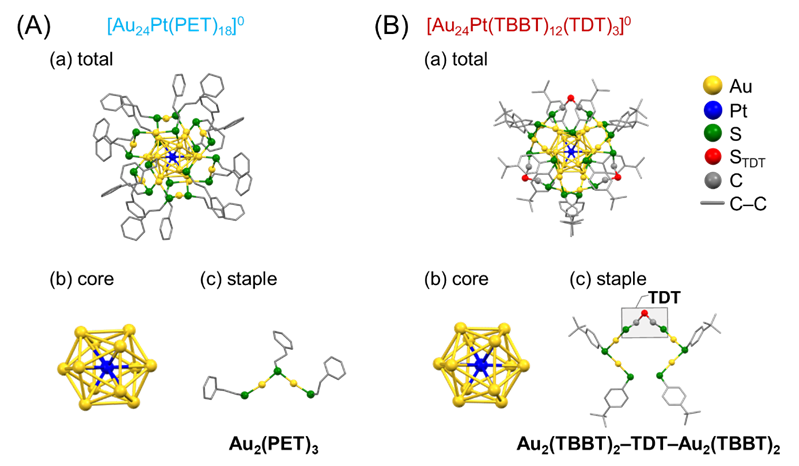
図1. (A) [Au24Pt(PET)18]0及び (B) [Au24Pt(TBBT)12(TDT)3]0の (a) 全体構造、(b) コア構造、(c) ステープル構造。
<関連情報>
- https://www.tohoku.ac.jp/japanese/2026/07/press20260710-03-Au24Pt.html
- https://pubs.acs.org/doi/10.1021/acs.nanolett.6c01977
ジチオラート保護Au24Ptナノクラスターの配位子設計による熱触媒活性の向上 Ligand Engineering of Dithiolate-Protected Au24Pt Nanoclusters for Improved Thermocatalytic Activity
Riki NakataniTokuhisa Kawawaki,Sara Yoshikawa,Chaoqi Chen,Taishi Suzuki,Soichi Kikkawa,Satoshi Anada,Seiji Yamazoe,and Yuichi Negishi
Nano Letters Published: June 29, 2026
DOI:https://doi.org/10.1021/acs.nanolett.6c01977
Abstract
Thiolate-protected gold (Au) nanoclusters (NCs) are a well-established class of model NCs that have been extensively studied as catalysts for various reactions. However, many Au NCs feature surfaces completely passivated by ligands, leaving no exposed metal sites to serve as active centers. To address this issue, researchers have searched for methods to remove the ligands. However, simply introducing weakly bound ligands often compromises the structural stability of the NCs. In this study, we identified a novel Au NC that remains stable even with relatively weakly bound thiolate ligands by reinforcing the staple motifs through the introduction of dithiolate ligands. This Au NC exhibits excellent CO oxidation activity at relatively low temperatures, because the ligands can dissociate under relatively mild conditions. These findings show that advanced ligand engineering, beyond the metal core structure, significantly affects catalytic activity, providing a robust strategy for the design of diverse metal NC catalysts.
