2026-07-07 合肥物質科学研究院(HFIPS)
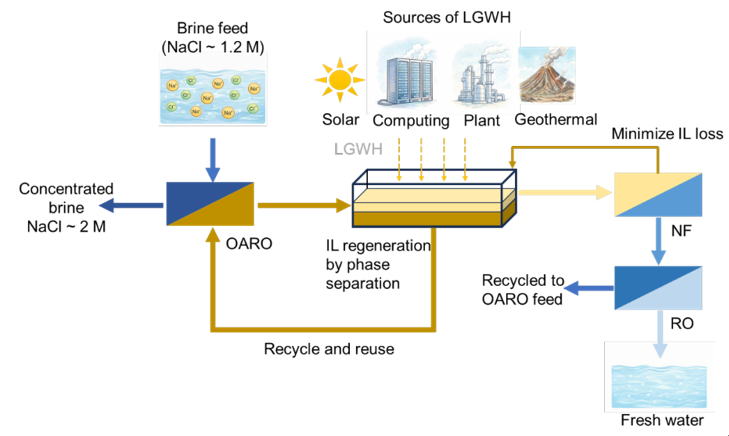
Schematic illustration of the thermoresponsive ionic liquid-based OARO process for high-salinity brine concentration. (Image by WANG Zhongzhen)
<関連情報>
- https://english.hf.cas.cn/nr/bth/202607/t20260707_1176541.html
- https://www.sciencedirect.com/science/article/pii/S0376738826006976
熱応答性イオン液体を浸透圧補助逆浸透における回収可能な吸引溶質として利用する:実験、輸送メカニズム、およびプロセスへの影響 Thermo-responsive ionic liquids as recoverable draw solutes for osmotically assisted reverse osmosis: Experiments, transport mechanisms, and process implications
Zhongzhen Wang, Zhenghan Zhou, Chunyan Xu
Journal of Membrane Science Available online: 20 June 2026
DOI:https://doi.org/10.1016/j.memsci.2026.125816
Highlights
- Bench-scale demonstration of ionic-liquid-driven OARO for brine concentration.
- Ionic liquid draw solutions recovered via phase separation and nanofiltration.
- Mass-transfer mechanisms quantified using finite-difference modeling.
- Process analysis reveals counter-intuitive energy consumption behavior.
Abstract
High-salinity brines remain challenging for conventional membrane desalination, motivating the exploration of alternative membrane-based process routes beyond standard reverse osmosis. Thermoresponsive ionic liquids (TRILs) have attracted interest as draw solutes for osmotically assisted reverse osmosis (OARO) due to their non-volatility, high osmotic pressure, reduced reverse solute flux, and regenerability using low-grade waste heat. In this work, we report, to the best of our knowledge, the first experimental demonstration of TRIL-based OARO using the thermoresponsive ionic liquid [P4444][DMBS]. A bench-scale OARO system was constructed and operated under realistic salinity conditions, achieving stable water fluxes of 1.5–3 LMH. Upon thermal phase separation, the majority of the ionic liquid partitions into the IL-rich phase for direct reuse. The water-rich phase contains diluted ionic liquid and moderate salinity (0.15–0.2 M NaCl), which requires downstream polishing. Two commercial nanofiltration membranes achieve 95–97% ionic liquid rejection at low operating pressures (∼20 bar), followed by reverse osmosis to produce high-quality water. A finite-difference mechanistic model and process-level energy analysis were developed for the TRIL-based OARO system. With two-stage nanofiltration, the per-cycle ionic liquid loss is reduced to approximately 0.2%. Counterintuitively, despite favorable experimental performance and efficient ionic liquid recovery, the modeled specific energy consumption reaches ∼6.60 kWh m−3, exceeding that of NaCl-based OARO (4.53 kWh m−3) under the same feed conditions due to the intrinsic energy penalties associated with NF polishing and RO finishing. The model suggests that substantially reduced membrane NaCl permeance or near-complete phase separation would be required for the process to approach competitive energy performance.