2026-07-06 東京科学大学
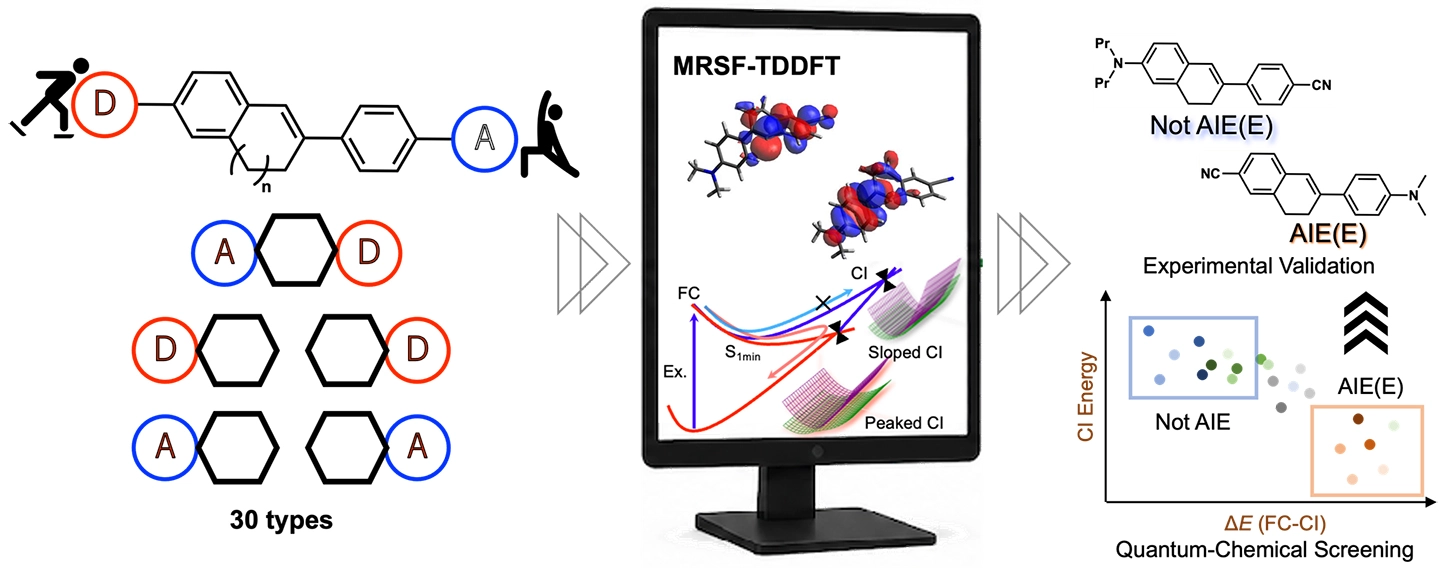
本研究の概要図
<関連情報>
- https://www.isct.ac.jp/ja/news/ru4kzgijvxw1
- https://advanced.onlinelibrary.wiley.com/doi/10.1002/advs.76058
ドナー–アクセプター非対称性による円錐交差アクセシビリティの制御を通じた橋かけスチルベンAIE色素における励起状態失活の計算ガイド型制御 Computation-Guided Control of Excited-State Deactivation through Modulation of Conical-Intersection Accessibility by Donor–Acceptor Asymmetry in Bridged Stilbene AIE Luminogens
Takuya Tanaka, Satoshi Suzuki, Hirosato Koyanagi, Kiyoshi Miyata, Riki Iwai, Kazunobu Igawa, Ken Onda, Ben Zhong Tang, Gen-ichi Konishi
Advanced Science Published: 18 June 2026
DOI:https://doi.org/10.1002/advs.76058
ABSTRACT
A computation-guided investigation of asymmetric donor–acceptor bridged stilbenes reveals structure–property relationships governing conical intersection (CI) accessibility and excited-state deactivation in aggregation-induced emission (AIE) luminogens. Although CIs play a central role in nonradiative decay, the molecular factors governing CI accessibility in AIE systems remain insufficiently understood. Here, we show that asymmetric donor–acceptor placement combined with bridge-controlled structural flexibility strongly influences CI accessibility and excited-state deactivation in push–pull alkylene-bridged stilbenes ([6]/[7]). Quantum-chemical analyses of 30 derivatives reveal substituent-dependent energetic trends associated with CI accessibility that can be rationalized by the relative energetic positions of the Franck–Condon and CI geometries. On the basis of these trends, representative derivatives, including DCBS[6], DCBS[7], DPB[7]C, and DPB[7]N, were synthesized together with reference compounds. Their photophysical properties generally correlate with the computed CI-accessibility trends, indicating that donor–acceptor asymmetry and bridge rigidity cooperatively influence excited-state deactivation and fluorescence suppression in solution. Time-resolved spectroscopy, post-relaxation PES analyses, and CI topology analyses further support the proposed relaxation pathways and suggest that substituent inversion alters CI energetics, topology, and nonadiabatic coupling. These findings provide mechanistic insight into substituent-dependent excited-state deactivation in bridged stilbenes.