2026-07-01 大阪大学
<関連情報>
- https://www.sci.osaka-u.ac.jp/ja/topics/16946/
- https://www.sci.osaka-u.ac.jp/ja/wp-content/uploads/2020/08/pr_kobayashi20260701.pdf
- https://www.nature.com/articles/s41467-026-74148-z
連続的に活性化される多経路エネルギー散逸によるエラストマーの強化 Toughening elastomer via sequentially activated multi-pathway energy dissipation
Xue Li,Chunlin Xiao,Haruki Izutsu,Osamu Urakawa,Tadashi Inoue,Yuichiro Kobayashi & Hiroyasu Yamaguchi
Nature Communications Published:01 July 2026
DOI:https://doi.org/10.1038/s41467-026-74148-z
Abstract
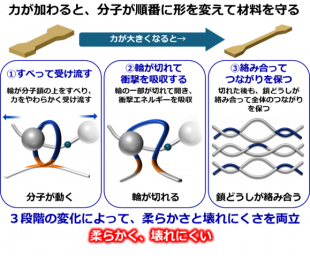
Auxiliary energy dissipation pathways have been incorporated into elastomer design to enhance the toughness. However, most strategies involving multiple pathways rely on non-synergistic dissipation that ceases to function once structural evolution occurs. Herein, we report a strategy to toughen elastomer via sequentially activated multi-pathway energy dissipation, simultaneously integrating mechanically interlocked networks (MINs), scissile mechanophore, and woven networks within a single polymer. A rotaxane crosslinker is applied to construct MINs in polyurethane as the primary energy dissipation pathway. After the sliding motion of the rotaxane crosslinkers reaches its maximal extent, the truxinate mechanophore embedded in rotaxane’s macrocycle undergoes sacrificial scission as the secondary pathway. Subsequently, the linear chain produced by cleavage of the rotaxane’s macrocycle inherently entangles with the axle chain, resulting in woven networks as the tertiary energy dissipation pathway. This strategy substantially enhances the toughness and clarifies how mechanophore activation interacts with supramolecular architecture in polymeric materials.