2026-06-29 産業技術総合研究所
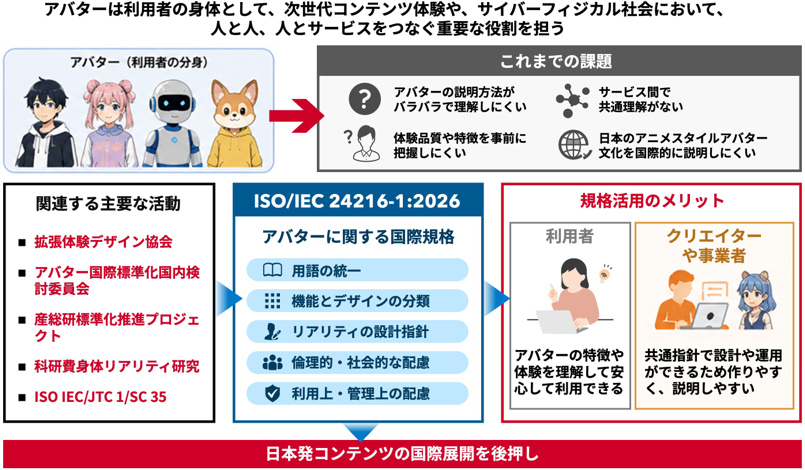
アバターに関する国際規格ISO/IEC 24216-1:2026の位置付けと期待される効果
<関連情報>
- https://www.aist.go.jp/aist_j/press_release/pr2026/pr20260629/pr20260629.html
- https://ieeexplore.ieee.org/abstract/document/11236381
- https://link.springer.com/chapter/10.1007/978-3-031-06509-5_9
- https://www.jstage.jst.go.jp/article/jsmbe/Annual59/Proc/Annual59_811/_article
xR体験を評価するための共通プラットフォームと方法論に関する提案 A Proposal for a Common Platform and Methodology for Evaluating xR Experiences
Junji Ohyama
2025 IEEE International Symposium on Mixed and Augmented Reality Adjunct Date Added to IEEE Xplore: 18 November 2025
DOI:https://doi.org/10.1109/ISMAR-Adjunct68609.2025.00096
Abstract
While xR (including VR, AR, MR) technologies enable immersive and high-fidelity user experiences, there remains a lack of established methods for designing such experiences across multidimensional and voluminous information spaces. This paper proposes a verification methodology and a dedicated evaluation platform “Xperigrapher”, and design process with collaborative framework to propose international standards or guidelines for safe and efficient xR contents and applications by using this standardized common platform.
三人称視点で提示されたアバターに対する所有権と主体性を引き出す方法:視覚運動フィードバックと触覚フィードバックの効果 How to Elicit Ownership and Agency for an Avatar Presented in the Third-Person Perspective: The Effect of Visuo-Motor and Tactile Feedback
Ryo Hanashima & Junji Ohyama
Human Interface and the Management of Information: Applications in Complex Technological Environments Published:16 June 2022
DOI:https://doi.org/10.1007/978-3-031-06509-5_9
Abstract
The realism of experience of using a virtual body in virtual reality (VR) is associated with ownership (one’s self-attribution of a body) has been shown. However, whether or not ownership can be elicited for a virtual body presented by the third-person perspective is under debate. This study investigated the effect of multimodal presentations on the ownership of a male virtual body presented in the third-person perspective in three conditions (Visuo-tactile, visuo-motor, visuo-motor-tactile condition) (N = 40). We compared the illusory effect of ownership in the three conditions in male and female participants using a questionnaire and a 2 × 3 mixed-design ANOVA. Our study revealed that the male participants in the visuo-motor-tactile condition affirmed moderate (+1) of ownership, but the female participants did not. Ownership was significantly higher in the visuo-tactile (p < .01) and visuo-motor (p < .05) conditions. The results suggest that both visuo-motor synchrony and visuo-tactile feedback are essential factors to induce ownership to the virtual body in a third-person perspective. Moreover, our data suggest that matching the participant’s gender identity and the appearance of an avatar’s gender might be important for elicited ownership. Additionally, we evaluated the agency on the virtual body in the third-person perspective in the same three feedback conditions and found that only visuo-motor feedback is essential to elicit agency, unlike the causal factors of the ownership.
Xperigrapher:サイバーフィジカル社会における体験を評価するためのソーシャルラボ実験プラットフォーム Xperigrapher: Social-Lab Experimental Platform to Evaluate Experience in Cyber Physical Society
Junji Ohyama
Transactions of Japanese Society for Medical and Biological Engineering Published:2021
DOI:https://doi.org/10.11239/jsmbe.Annual59.811
Abstract
Despite contributions to international standards for accessible information design for elderly and disabled persons, there still exists difficulty in addressing the specific needs of daily living contexts. In recent years, the application of virtual reality (VR) has been proposed to reproduce living scenarios in virtual spaces for behavior and training evaluation. This study proposed a no-code VR experimental platform which can evaluate human behavior and cognition in cyber physical society by reproducing experiences of various living scenarios by using a single comprehensive multimodal VR system. Furthermore, it is predicted that the COVID-19 pandemic will further raise the demand for cyber-social-lab research methods such as this platform that can simulate interaction with persons and things in virtual space in social situations requiring greatly reduced close-contact.