2026-06-25 中国科学院(CAS)
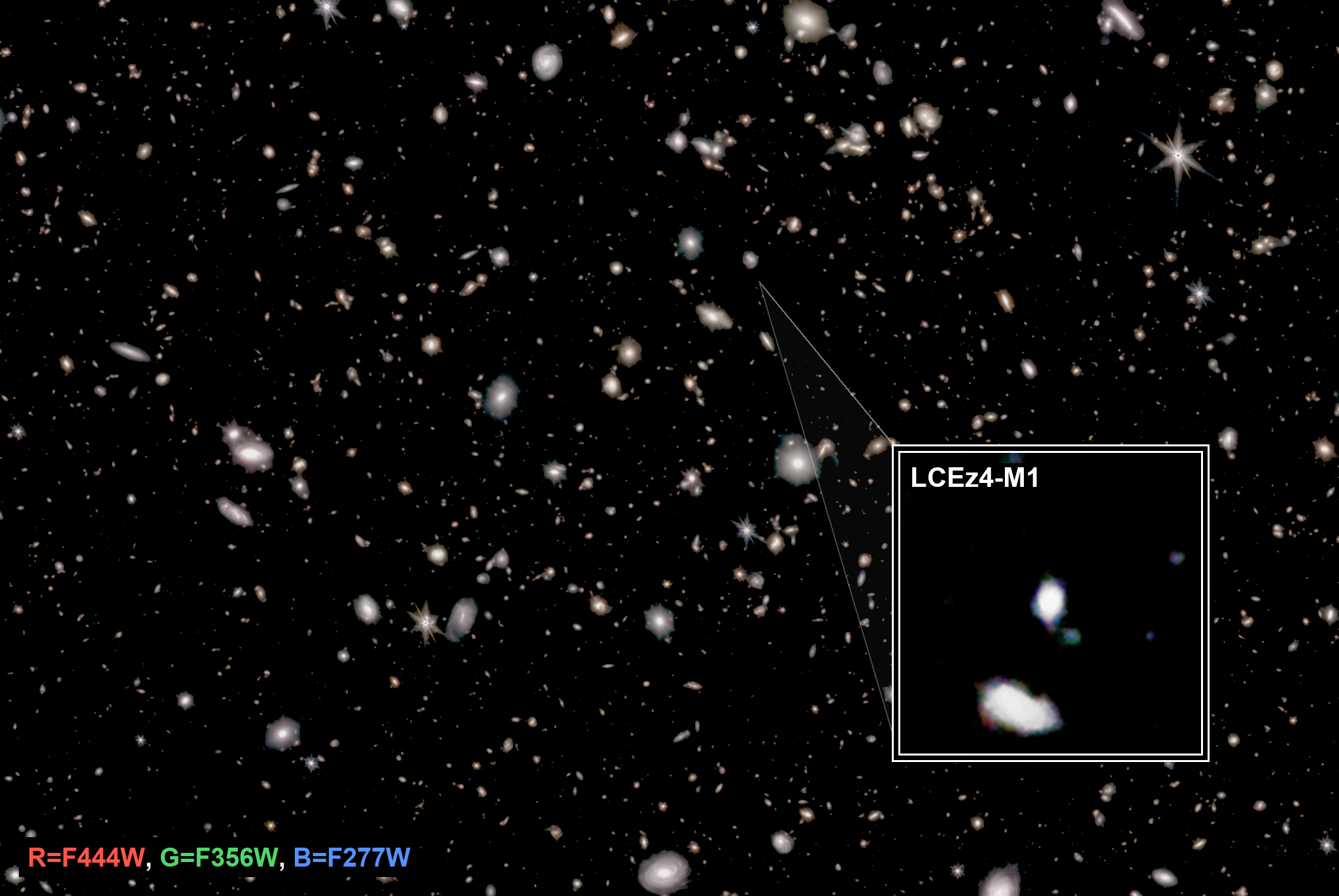
The highest-redshift Lyman continuum galaxy candidate known to date, LCEz4-M1. (Image by SHAO)
<関連情報>
- https://english.cas.cn/newsroom/research-news/202606/t20260625_1174850.shtml
- https://iopscience.iop.org/article/10.3847/2041-8213/ae75e1
LCEz4-M1: MUSEハッブル超深宇宙領域におけるz = 4.444のライマン連続光放射候補天体 LCEz4-M1: A Lyman Continuum Emitter Candidate at z = 4.444 in the MUSE Hubble Ultra Deep Field
Shuairu Zhu, Zhen-Ya Zheng, Fuyan Bian, Fang-Ting Yuan, Chunyan Jiang, Xiaer Zhang, Ruqiu Lin, and Yucheng Guo
The Astrophysical Journal Letters Published: 2026 June 22
DOI:10.3847/2041-8213/ae75e1
Abstract
High-redshift Lyman continuum emitters (LCEs) are crucial for understanding how galaxies ionize the neutral hydrogen in the epoch of reionization. However, detected LCEs at z > 4 are quite rare. Here, we report an LCE candidate at z = 4.444, dubbed LCEz4-M1, which is one of the highest-redshift LCE candidates currently known. The redshift is determined from the Lyα emission line detected in the Very Large Telescope (VLT)/MUSE spectrum. The Lyman continuum (LyC) signal is detected independently in the Hubble Space Telescope F435W image and the VLT/MUSE spectrum at significances of ≃3.7σ and ≃2.8σ–3.0σ, respectively. The LyC centroid is spatially consistent with the James Webb Space Telescope (JWST)/NIRCam continuum within the astrometric uncertainty. Adopting the maximum intergalactic medium transmission, we infer conservative lower-limit escape fractions of fesc(F435W)=0.82+0.13-0.17 and fesc(MUSE)=0.75+0.18-0.28. Using the combined JWST and MUSE dataset, we characterize the physical properties and morphology of LCEz4-M1. In our fiducial JWST-only spectral energy distribution fit, the galaxy is compact but has a moderate current galaxy-integrated star formation surface density, ΣSFR = 0.38 M⊙ yr−1 kpc−2, suggesting that it is not an extreme compact starburst under this fiducial interpretation. While we find no clear evidence for an ongoing major merger for LCEz4-M1, the presence of a faint companion (∼0.”5) detected in the F277W band suggests a potential minor interaction. We also find that LCEz4-M1 may lie in a locally overdense region, although the environmental interpretation remains tentative. Finally, the low star formation ratio, SFR10 Myr/SFR100 Myr, low Lyα equivalent width, and relatively weak rest-frame optical emission lines of LCEz4-M1 may indicate a postburst LyC leaking phase.