2026-06-18 スイス連邦工科大学ローザンヌ校(EPFL)
<関連情報>
- https://actu.epfl.ch/news/permafrost-is-not-simply-a-carbon-time-bomb/
- https://www.nature.com/articles/s41586-026-10664-8
岩石の風化は、永久凍土の融解によって引き起こされる河川からのCO2排出量を相殺することができる Rock weathering can counteract river CO2 emissions induced by permafrost thaw
Liwei Zhang (张力伟),Aaron Bufe,Joshua F. Dean,Gerard Rocher-Ros,Ryan A. Sponseller,Emily H. Stanley,Jan Karlsson,David E. Butman,Ran Liu (刘然),Lijun Hou (侯立军),Jinzhi Ding (丁金枝),Shilong Piao (朴世龙),Xinghui Xia (夏星辉) & Tom J. Battin
Nature Published:17 June 2026
DOI:https://doi.org/10.1038/s41586-026-10664-8
Abstract
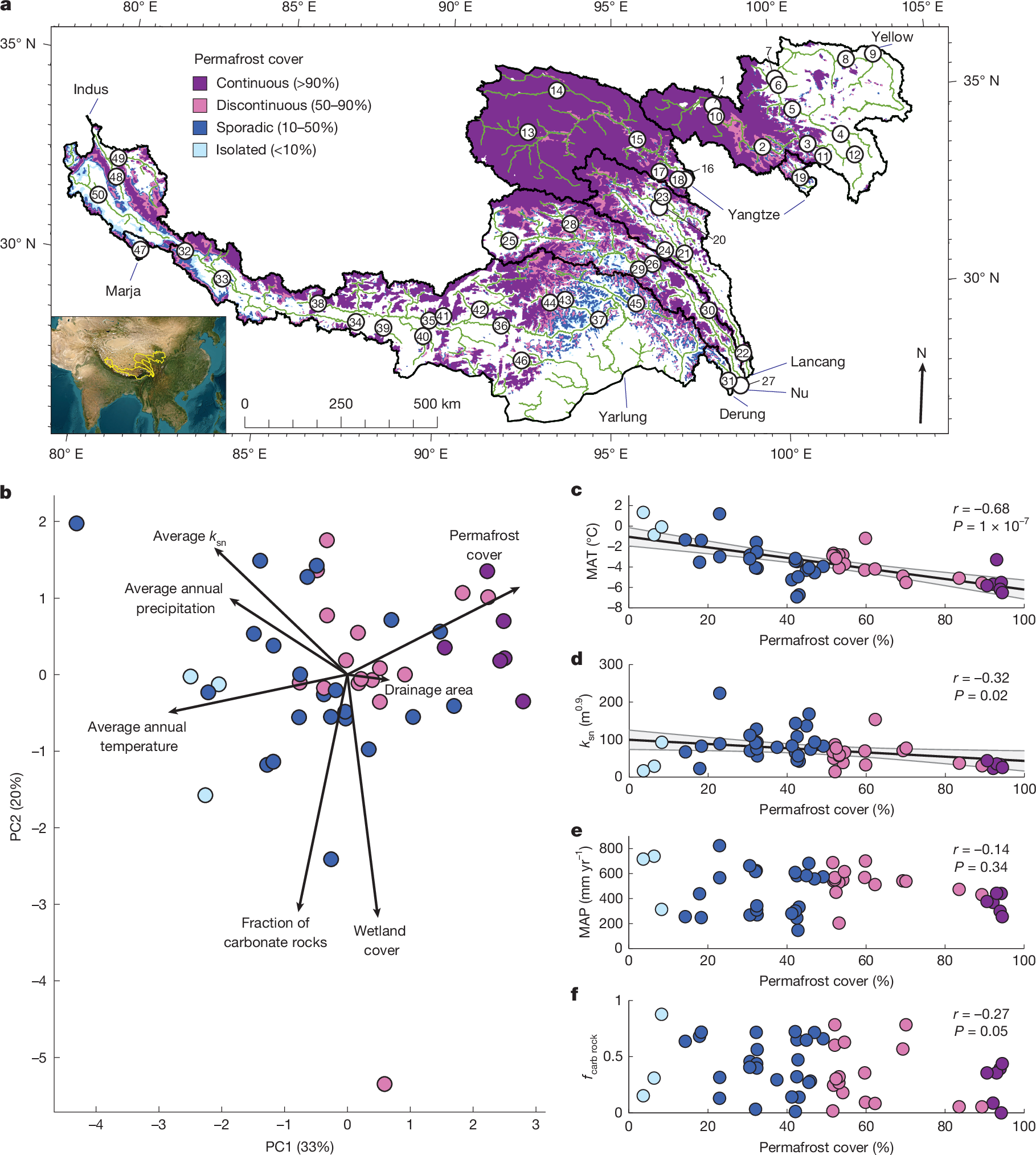
Climate-induced permafrost thaw unlocks large stores of organic carbon that are mineralized and emitted as carbon dioxide (CO2) from rivers to the atmosphere1. Concurrently, warming and permafrost thaw can increase mineral weathering rates, thus affecting the release and sequestration of inorganic carbon2,3,4. Yet how these biological and geological carbon cycles interact and jointly affect CO2 dynamics (emission compared with drawdown) in permafrost rivers remains unknown5. Here we combine CO2 emissions, organic and inorganic solute concentrations, dual carbon isotopes (δ13C–Δ14C) and geochemical modelling to infer how permafrost thaw may affect river biogeochemistry over decades to centuries across the Qinghai–Tibet Plateau. Leveraging a gradient of thermal permafrost degradation, we find that river CO2 emissions decline, whereas solute fluxes from rock weathering increase with decreasing permafrost cover. Across this region, net CO2 drawdown fluxes from rock weathering are about 35% of river CO2 emissions, varying from around 15% in catchments with continuous permafrost to more than 100% in catchments with discontinuous or isolated permafrost. Thus, carbon fluxes from chemical weathering may become increasingly important with ongoing permafrost thaw, potentially even outpacing river CO2 emissions. Our findings disentangle the interplay between biological and geological carbon fluxes that are important for the cryosphere and the global carbon cycle.