2026-06-11 マサチューセッツ工科大学(MIT)
◆実験では従来手法より鮮明な画像取得に成功し、視界が極めて悪い条件でも有効性が確認された。研究チームは、この技術が海洋観測、水中ロボットの航行支援、港湾や橋梁などのインフラ点検、水中考古学、環境モニタリングなど幅広い分野で活用できると期待している。特に濁水域や深海環境における調査能力の向上につながり、水中探査の効率化と安全性向上に貢献する可能性がある。
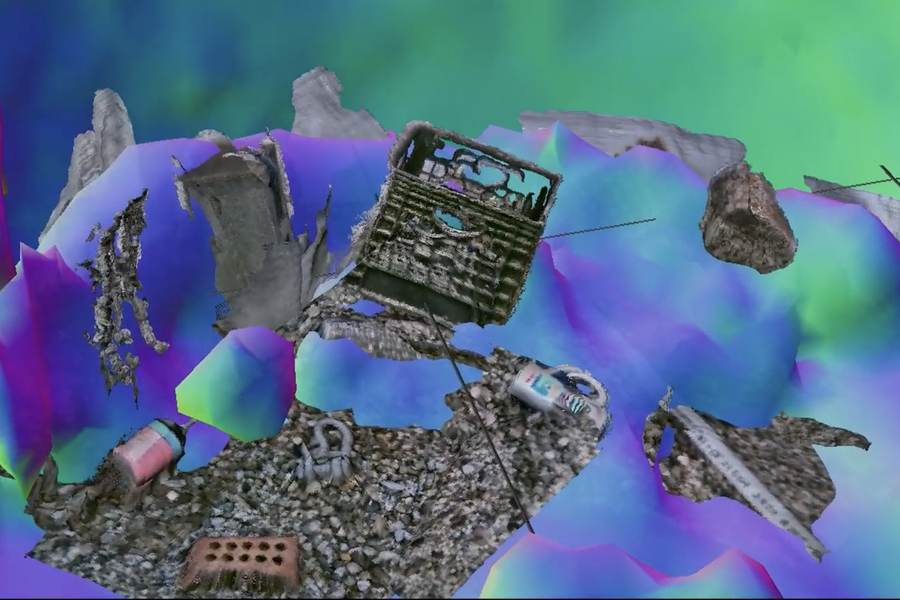
The new underwater mapping technique is akin to pairing a dolphin’s echolocation with a sea turtle’s close-range vision to see and navigate through murky water, in real-time. Credit: Courtesy of the researchers
<関連情報>
- https://news.mit.edu/2026/new-imaging-system-sees-through-murky-waters-0611
- https://dspace.mit.edu/entities/publication/46d5fb92-afff-4f32-9cd4-16d988b2271d
Sonar-MASt3R:濁った非構造環境におけるリアルタイム光音響融合 Sonar-MASt3R: Real-Time Opti-Acoustic Fusion in Turbid, Unstructured Environments
Phung, Amy • Camilli, Richard
IEEE Robotics and Automation Society Date Issued:June 2026
Abstract
Underwater intervention is an important capability in several marine domains, with numerous industrial, scientific, and defense applications. However, existing perception systems used during intervention operations rely on data from optical cameras, which limits capabilities in poor visibility or lighting conditions. Prior work has examined opti-acoustic fusion methods, which use sonar data to resolve the depth ambiguity of the camera data while using camera data to resolve the elevation angle ambiguity of the sonar data. However, existing methods cannot achieve dense 3D reconstructions in real-time, and few studies have reported results from applying these methods in a turbid environment. In this work, we propose the opti-acoustic fusion method Sonar-MASt3R, which uses MASt3R to extract dense correspondences from optical camera data in real-time and pairs it with geometric cues from an acoustic 3D reconstruction to ensure robustness in turbid conditions. Experimental results using data recorded from an “opti-acoustic eye-in-hand” configuration across turbidity values ranging from <0.5 to >12 NTU highlight this method’s improved robustness to turbidity relative to baseline methods.