
2026-06-12 オックスフォード大学
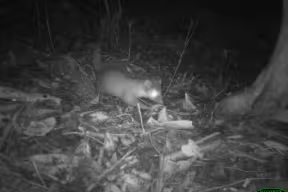
Bornean ferret badger identified in an extensive camera trap survey conducted by the research team. Image credit: AJ Hearn
<関連情報>
- https://www.ox.ac.uk/news/2026-06-12-new-study-reveals-that-sabahs-ferret-badger-is-found-nowhere-else-on-earth
- https://onlinelibrary.wiley.com/doi/10.1002/ece3.73756
ボルネオイタチアナグマの分布、生息地の利用、および保全Distribution, Habitat Use and Conservation of the Bornean Ferret Badger
Andrew J. Hearn, Mohammad Aliyuddin bin Jaini, Caroline Charão Sartor, Pg Mohd Sahlan bin Salam, Andy Martin, Chrishen Gomez, David W. Macdonald
Ecology and Evolution Published: 03 June 2026
DOI:https://doi.org/10.1002/ece3.73756
ABSTRACT
The Bornean ferret badger (Melogale everetti) is one of Southeast Asia’s most geographically restricted carnivores and is listed as Endangered, yet its ecology, distribution and conservation needs remain poorly understood. We conducted multi-site camera-trap surveys across Sabah’s western mountain massif—the species’ only confirmed area of occurrence—and integrated these data with multi-scale habitat suitability modelling and landscape connectivity analyses to refine its probable range, habitat associations and movement potential. Surveys yielded 407 independent detections from 60 camera stations, including the first confirmed records from Nuluhon–Trusmadi Forest Reserve, extending the verified distribution eastward beyond the Kinabalu–Crocker axis. Estimated detection probability per sampling occasion was generally low, but occupancy modelling indicated widespread site use, with highest model-based occupancy in Tenompok Forest Reserve and a mixed farmland site, and similarly high values in adjacent Kinabalu Ecolinc and southern Kinabalu Park. Habitat suitability was primarily associated with topographic position index and soil properties, suggesting edaphic and landform associations consistent with fossorial foraging ecology. The Sunda stink badger (Mydaus javanensis), an ecologically similar musteloid, was detected in only two highland areas, both of which lacked or supported very low ferret badger occurrence; this segregation is consistent with (but not definitive evidence for) interspecific competition. Connectivity analyses revealed contiguous Bornean ferret badger movement zones within core habitat patches but no functional corridors between them, highlighting the importance of the Kinabalu Ecolinc for demographic exchange. Model-based estimates of Area of Occupancy (2424 km2) and Extent of Occurrence (4795.6 km2) exceed previous IUCN values but remain consistent with Endangered status. Our findings identify priority upland conservation areas, emerging barriers to connectivity, and provide a robust basis for conservation planning in Sabah’s montane landscapes.

