2026-06-03 中国科学院(CAS)
従来の多機能センサーは複数のセンサー素子や異なる機能材料を組み合わせる必要があり、構造の複雑化や小型化の制約が課題だった。また、ひずみと温度の信号が相互干渉し、正確な測定が困難であった。研究チームは、Bi₂Te₃(テルル化ビスマス)/ポリイミド(PI)薄膜の熱電効果とピエゾ抵抗効果を単一素子内で活用し、熱電圧を温度信号として利用することで、温度変化による抵抗値ドリフトを補正する自己補償機構を実現した。さらに、キャリア濃度の制御によってゼーベック係数とゲージ率を同時に向上させ、温度検知性能とひずみ検知性能を強化した。
試作センサーを指に装着した実験では、指の曲げ動作を識別すると同時に接触物体の温度を測定できることを実証した。本研究は、人間と機械のインターフェース、ソフトロボティクス、スマート義肢向けの高集積・小型多機能センサー開発に新たな基盤を提供するものである。
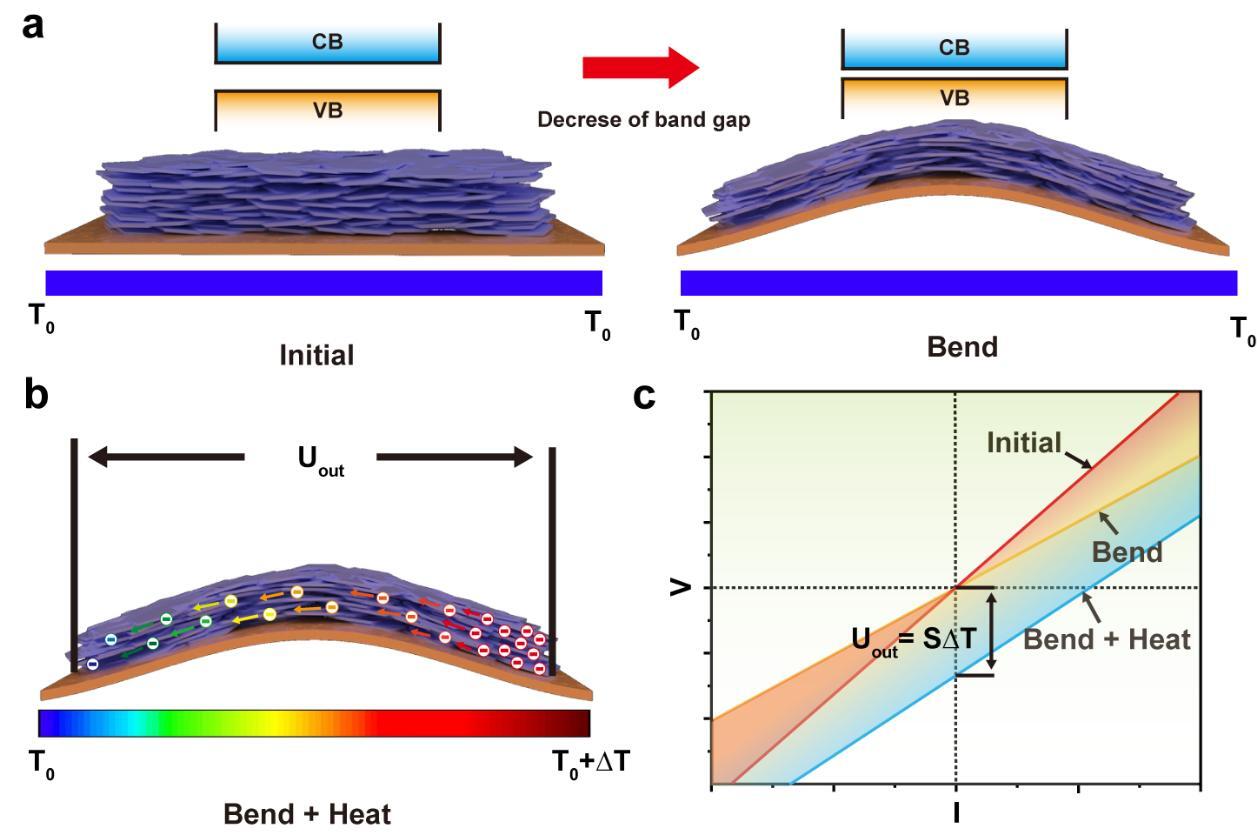
Temperature-strain sensing mechanism of the Bi2Te3/polyimide film. (Image by IMR)
<関連情報>
- https://english.cas.cn/newsroom/research-news/202606/t20260603_1161046.shtml
- https://advanced.onlinelibrary.wiley.com/doi/10.1002/adfm.75966
ジェスチャー認識と温度感知を同時に行う自己補償型デュアル機能センサー A Self-Compensated Dual-Function Sensor for Simultaneously Gesture Recognition and Temperature Perception
Hailong Yu, Shengqian Li, Junru Zhao, Dayi Zhou, Juan He, Wenxia Li, Hao Zeng, Yijun Ran, Yang Zhao, Zhi Yu, Kaiping Tai
Advanced Functional Materials Published: 22 May 2026
DOI:https://doi.org/10.1002/adfm.75966
ABSTRACT
Multifunctional flexible sensors utilizing a single active material are crucial for creating compact, integrated, and mechanically compliant human–machine interaction systems. However, when multiple physical effects coexist in one material, intrinsic multi-physics coupling often causes signal crosstalk and affects sensing accuracy. Herein, a temperature-strain dual-function sensor based on a Bi2Te3 film is constructed and a self-compensation strategy is introduced to suppress temperature-induced drift in the strain readout. The thermoelectric voltage generated by the Bi2Te3 film serves as an in situ temperature indicator to correct the influence of temperature drift on the strain-sensing signal. Consequently, the impact of temperature on the relative error of strain sensing decreased from −4.6 to 6% K−1, making an 87% reduction in absolute terms. Furthermore, a wearable gesture recognition and temperature perception system was established and enabled simultaneous recognition of various postures, deformation degrees, and object/environmental temperature changes. This system highlights the potential of single-material-based self-compensated sensors in intelligent interactive electronics, representing an important step forward in advancing the practical application.