
2026-06-04 東京大学
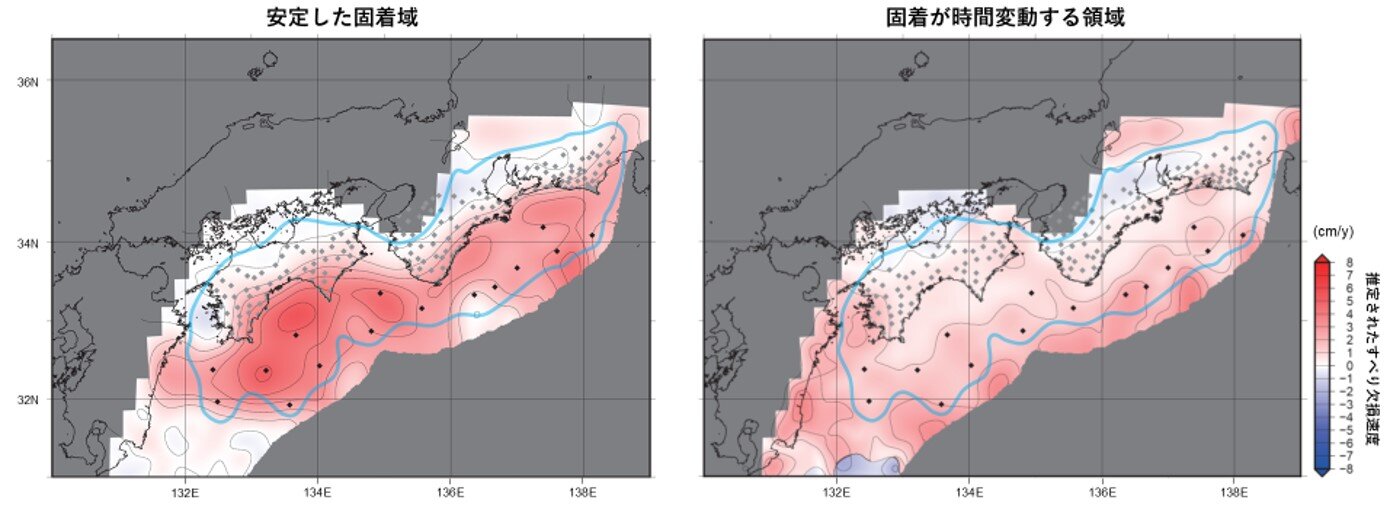
(左) 2013-2023年の11年間のすべり欠損速度の全期間の最小値の分布。
(右) すべり欠損速度の平均値と最小値の差の分布。
<関連情報>
- https://www.iis.u-tokyo.ac.jp/ja/news/5081/
- https://link.springer.com/article/10.1186/s40623-026-02472-1
10年にわたる海底測地調査により、南海トラフ沿いの常に固着している領域と、滑り不足率の時間的変化が明らかになった Decadal seafloor geodesy reveals constantly locked areas and temporal changes in the slip deficit rate along the Nankai Trough
Yusuke Yokota,Shun-ichi Watanabe,Koya Nagae,Yuto Nakamura,Akemi Noda & Tadashi Ishikawa
Earth,Planets and Space Published:03 June 2026
DOI:https://doi.org/10.1186/s40623-026-02472-1
Abstract
Identifying the frictionally locked area of a plate boundary is an important geodetic issue in mitigating earthquake disasters. However, recent long-term geodetic observations have revealed that actual geodetic data contain transient behaviors due to slow slip events or changes in slip deficit rates. Therefore, the use of a snapshot of temporally averaged geodetic data is far insufficient to understand the accurate frictional state. This problem is particularly serious at sub-seafloor plate boundaries, where continuous or periodic geodetic observations spanning a long time are rarely realized. Here, we evaluated long-term slip deficit rate variations in the Nankai Trough, the only area in the world for which high-density data on horizontal and vertical components have been accumulated via seafloor observations with a sufficient frequency on the decadal scale. We also estimated the stress accumulation rate distribution using the slip deficit distribution to discuss stress condition. Consequently, we constrained the constantly locked areas and found that it was limited mainly to a depth of 10–20 km, with slip deficit rate changes occurring throughout the entire shallow side adjacent to the locked area.

