20206-05-27 北海道大学,東海大学,札幌市円⼭動物園
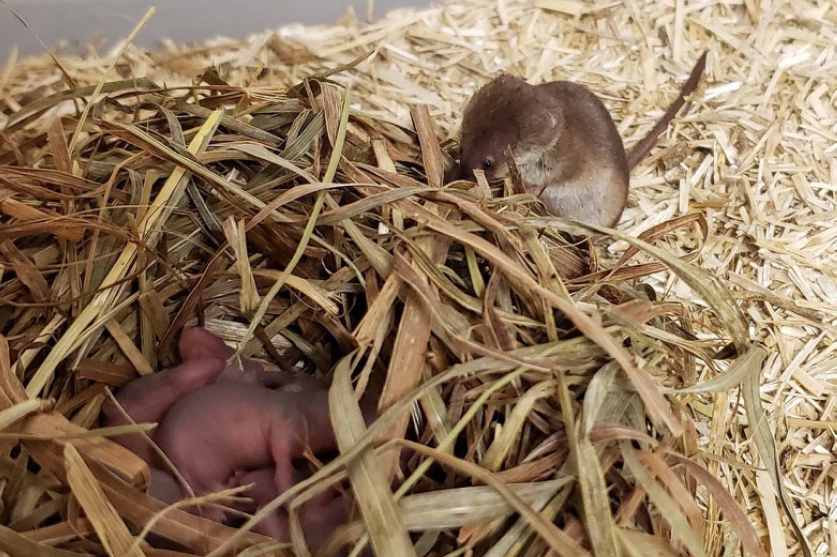
飼育下で繁殖をしたヒメトガリネズミの親子。右上が母親、左下が新生仔。成獣の体重は3~4グラム程度で、北海道に生息する4種のトガリネズミの中で2番目に小さい。
<関連情報>
- https://www.hokudai.ac.jp/news/2026/05/post-2297.html
- https://bioone.org/journals/mammal-study/volume-51/issue-3/ms2025-0020/Breeding-Behavior-and-Growth-of-Young-in-Captive-Slender-Shrews/10.3106/ms2025-0020.full
ヒメトガリネズミの飼育下における繁殖行動と幼獣の成長 Breeding Behavior and Growth of Young in Captive Slender Shrews, Sorex gracillimus
Shinnosuke Kuboshima, Konomi Kobayashi, Natsumi Iijima, Naoya Honda, Kuniko Kawai, Satoshi D. Ohdachi
Mammal Study Published:4 May 2026
DOI:https://doi.org/10.3106/ms2025-0020
Abstract
We attempted to establish a captive breeding population of slender shrews (Sorex gracillimus) using wild-caught individuals from Hokkaido, Japan. Seventeen pairs (26 pairing trials) were tested using 13 individuals (nine females and four males) born either in captivity or the wild. Among them, nine were female–female pairs (10 trials) due to difficulties in sex determination. Most pairings showed no severe aggression, though some antagonism occurred in three female–female trials. Mounting was observed in seven of 16 trials (eight female–male pairs), three of which resulted in pregnancy. Unlike some other shrew species that exhibit courtship dancing and persistent male chasing, S. gracillimus showed no such behaviors. Instead, “gentle” mutual chasing and pre-mating contact or “flirting” were sometimes observed. Mounting frequency ranged from 0.40 to 0.83 events per hour, with mean durations of 91.6 to 1247.3 seconds per trial. The gestation period was estimated at 25–29 days, and the weaning period at 25–30 days. Growth of young born to wild-caught females was also recorded. These findings provide insights into the reproductive behavior of S. gracillimus, which were further compared with other shrew species.