2026-05-27 産業技術総合研究所
<関連情報>
- https://www.aist.go.jp/aist_j/press_release/pr2026/pr20260527/pr20260527.html
- https://www.jstage.jst.go.jp/article/jcersj2/134/5/134_26015/_article
溶融急冷法で製造された高弾性率酸化物ガラス High-modulus oxide glasses fabricated by the melt-quenching method
Hirokazu Masai
Journal of the Ceramic Society of Japan Published: May 01, 2026
DOI:https://doi.org/10.2109/jcersj2.26015
Abstract
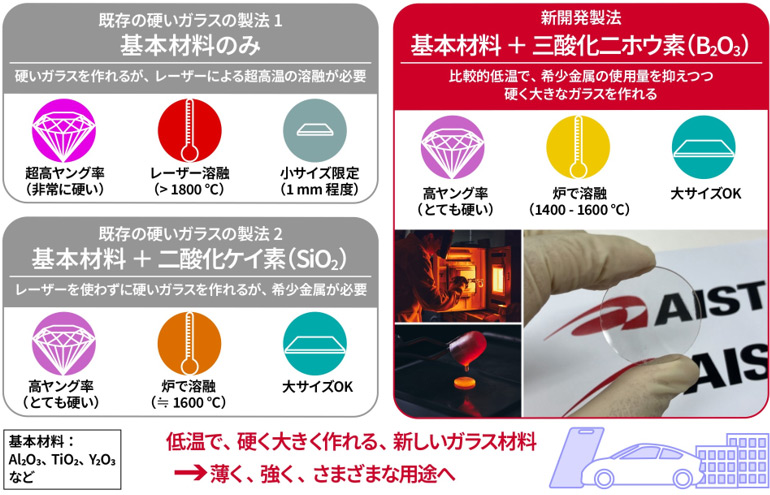
Many oxides with high dissociation energies also have high melting points; therefore, concurrently achieving a low glass transition temperature, high thermal stability, high optical transparency, and high mechanical strength is challenging. In this study, aluminoborate glasses with high hardnesses and Young’s moduli were prepared using the conventional melt-quenching method. The glasses exhibited packing densities greater than 0.59 and Poisson’s ratios of approximately 0.29, which are indicative of a densely packed network structure. The fabricated glasses had low glass transition temperatures (<760 °C) and high Young’s moduli (>120 GPa), as well as sufficient thermal stability for fiber drawing and transparency in the visible region. Developing oxide glasses with physical properties that are difficult to achieve is expected to expand the frontiers of material applications and drive further advancements in glass science.