

2026-05-21 テキサス大学オースチン校(UT Austin)
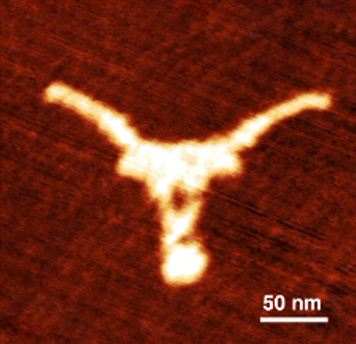
<関連情報>
- https://news.utexas.edu/2026/05/21/the-smallest-longhorn-ever-a-breakthrough-at-the-nanoscale/
- https://onlinelibrary.wiley.com/doi/10.1002/smll.202504855
DNA折り紙構造の折り畳みダイナミクスを解明する Unraveling the Folding Dynamics of DNA Origami Structures
Meysam Mohammadi-Zerankeshi, James Houston, Ogochukwu K.U. Elisha-Wigwe, Abi Sachi, Alexander E. Marras
Small Published: 19 October 2025
DOI:https://doi.org/10.1002/smll.202504855
Abstract
Achieving high folding yield remains a challenge in DNA origami, particularly as structures increase in complexity and scale. Here, how DNA origami design influences folding is investigated using a combination of real-time fluorometry, gel electrophoresis, electron microscopy, and theoretical analysis. Results reveal a balance of free energy changes from loop formation and hybridization that govern nucleation of nanostructure assembly, while the extent of cooperativity determines the overall assembly. The effect of structural complexity, staple design, and scaffold design on each energetic parameter, folding yield, kinetics, and cooperativity is measured. The results show that the scaffold pattern determines the extent of cooperativity, where fewer scaffold crossovers result in more cooperative folding. These findings use a tool developed in this work to estimate the extent of cooperativity in any structure. It is also found that limiting the number of crossovers per staple should be prioritized over extending staple binding domains, as the entropic penalty dominates the favorable binding. Finally, a 1–2 h focused annealing ramp strategy is demonstrated, that can increase yield up to 17% relative to traditional multi-day ramps. Optimizing energy changes and cooperativity through design can significantly enhance assembly yield and reduce time, particularly for complex structures, aiding large-scale DNA materials.

