2026-05-21 東京科学大学
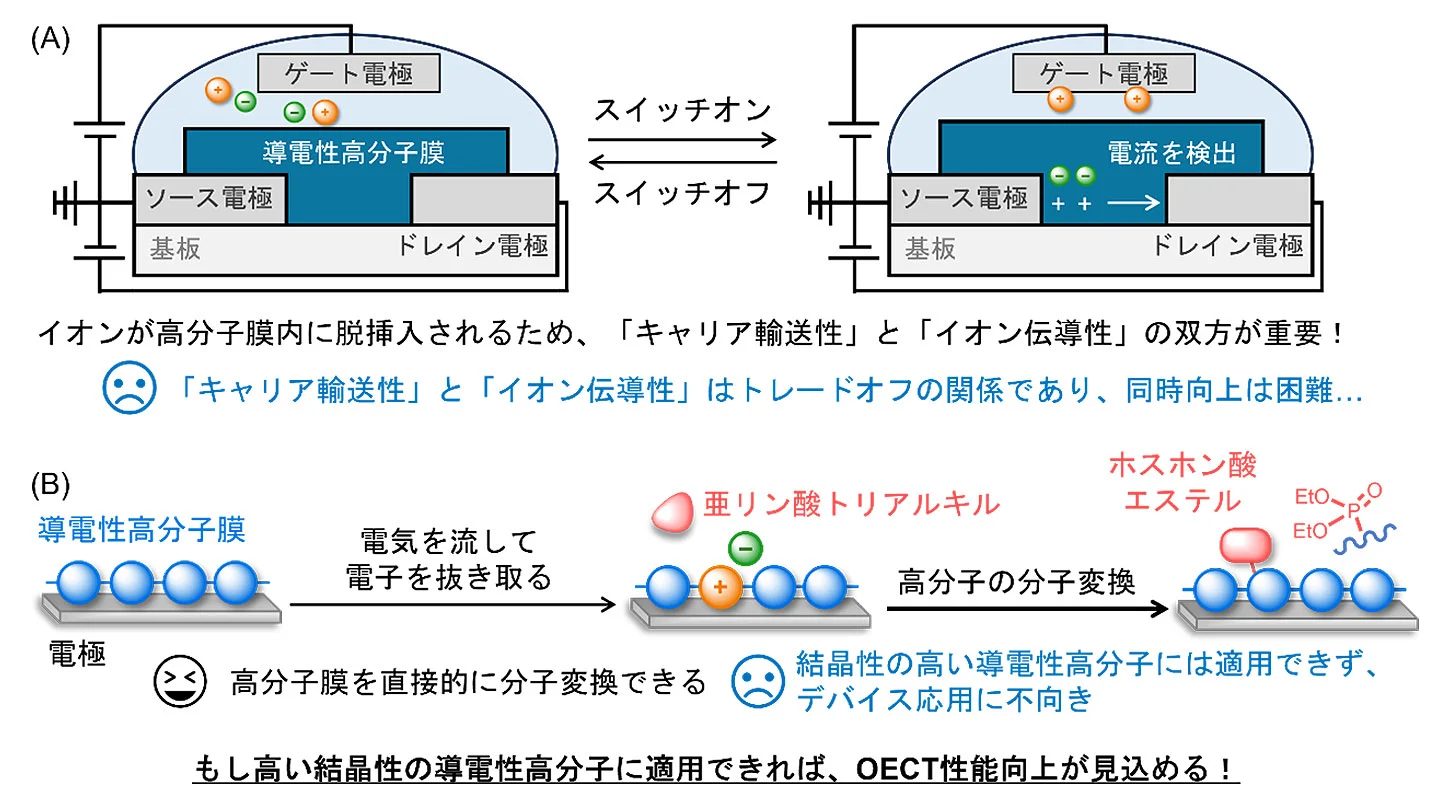
図1(A)OECTのスイッチオン/オフ時の概略図 (B)電気化学的な手法を用いた導電性高分子膜の分子変換法
<関連情報>
- https://www.isct.ac.jp/ja/news/a36fmov7ozl8
- https://onlinelibrary.wiley.com/doi/10.1002/anie.1180643
精密制御された電気化学的リン酸化:高性能有機電気化学トランジスタのためのπ共役ポリマー特性の最適化 Precisely Controlled Electrochemical Phosphonylation: Tailoring π-Conjugated Polymer Properties for High-Performance Organic Electrochemical Transistors
Kohei Taniguchi, Kosuke Sato, Shinsuke Inagi
Angewandte Chemie International Edition Published: 18 April 2026
DOI:https://doi.org/10.1002/anie.1180643
ABSTRACT
To achieve high performance, organic electrochemical transistor (OECT) channels must support efficient transport of electronic charges and ions. When designing polymeric mixed conductors, maintaining an appropriate balance between hydrophilic and hydrophobic characteristics plays a crucial role. Conventional hydrophilic side-chain modification involves costly synthesis and limits molecular design flexibility. Here, we demonstrate a degree of functionalization (DOF)-tunable electrochemical C–H phosphonylation strategy that enables precise post-functionalization of semicrystalline, high-mobility conjugated polymers, thereby providing a versatile route to optimize the hydrophilic–hydrophobic balance without monomer redesign. We applied this approach to semicrystalline polymers, for example, poly[2,5-bis(3-tetradecylthiophen-2-yl)thieno[3,2-b]thiophene] (PBTTT) and diketopyrrolo-pyrrole-dithienylthieno[3,2-b]thiophene (DPP-DTT), which exhibit excellent charge mobilities. The functionalization was successfully carried out in Nafion-composite films, yielding samples with DOF values up to 0.91. Systematic investigation revealed that the moderate functionalization (DOF = 0.06–0.16) enhanced the µC* values in OECTs by nearly two-fold compared to pristine polymers. In addition, the phosphonylated materials exhibited improved switching characteristics. These results quantitatively reveal a trade-off between enhanced ionic accessibility and retention of efficient charge-transport pathways in the polymers with increased DOF. This precisely tunable functionalization of the hydrophobic conjugated polymers represents a practical strategy for designing mixed ionic and electronic carrier conductors, further facilitating the development of high-performance OECT materials.