2026-05-20 慶應義塾大学,京都産業大学,東京大学,神戸大学,京都大学,理化学研究所
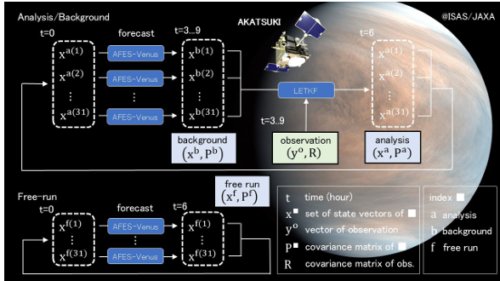
▲あかつきの観測データ (observation) と AFES-Venus による数値シミュレーションの予報データ (forecast) を、データ同化手法 LETKF により統合するしくみ。金星大気のより「確からしい」状態 (analysis) を時空間的に再構成した客観解析データALERA-Vの公開は、世界初の金星大気のオープンデータ化である。
<関連情報>
- https://www.keio.ac.jp/ja/press-release/20260520-press-01/
- https://www.keio.ac.jp/files/c2d1eb0a303f81192b71d65ada0c71700afc4ff17d311086d449cf0b3d9dba4e
- https://rmets.onlinelibrary.wiley.com/doi/10.1002/gdj3.70080
ALERA-V バージョン 1.0: 金星大気の客観的解析データセット ALERA-V Version 1.0: An Objective Analysis Dataset of the Venus Atmosphere
Yukiko Fujisawa, Shin-ya Murakami, Norihiko Sugimoto, Nobumasa Komori, Masahiro Takagi, Takeshi Imamura, Takeshi Horinouchi, George L. Hashimoto, Masaki Ishiwatari, …
Geoscience Data Journal Published: 12 May 2026
DOI:https://doi.org/10.1002/gdj3.70080
ABSTRACT
An objective analysis dataset of the Venus atmosphere, ALERA-V version 1.0, has been released. This objective analysis provides the best estimate of the state of the Venus atmosphere produced by combining observations and a forecast model weighted according to their respective levels of uncertainty. The accumulation of frequent observations by the Venus Climate Orbiter ‘Akatsuki’ has, for the first time, enabled an objective analysis of the Venus atmosphere. ALERA-V stands for AFES-LETKF experimental ensemble objective (re)analysis of the Venus atmosphere, and is generated by ALEDAS-V, the AFES-LETKF data assimilation system for the Venus atmosphere. ALEDAS-V uses AFES-Venus (Atmospheric General Circulation Model for the Earth Simulator for Venus) as a forecast model and the LETKF (Local Ensemble Transform Kalman Filter) for data assimilation. The observations of the zonal and meridional winds obtained by a cloud tracking technique from images taken by Akatsuki’s UVI (Ultraviolet Imager) are assimilated to produce ALERA-V version 1.0. The dataset consists of atmospheric variables defined on a grid of 128 longitude and 64 latitude points, and 60 vertical levels, with output every 6 Earth hours from September to December 2018, including the intensive observation period of November. ALERA-V is expected to be useful for both scientific and engineering research, such as understanding the dynamical mechanisms of various atmospheric phenomena and planning for future satellite missions, with appropriate consideration of its quality and limitations.