2026-05-08 産業技術総合研究所
<関連情報>
- https://www.aist.go.jp/aist_j/press_release/pr2026/pr20260508/pr20260508.html
- https://www.pnas.org/doi/10.1073/pnas.2528122123
ナノワイヤベースのAFM-IR顕微鏡:銀ナノワイヤで機能化されたAFMプローブを用いて、10nm以下の解像度で化学構造を解明する Nanowire-based AFM-IR microscopy: Unveiling chemical structure at sub-10-nm resolution with silver nanowire–functionalized AFM probes
Yasuhiko Fujita, Mariko Takahashi, Farsai Taemaitree, +1 , and Hirohmi Watanabe
Proceedings of the National Academy Sciences Published:April 30, 2026
DOI:https://doi.org/10.1073/pnas.2528122123
Significance
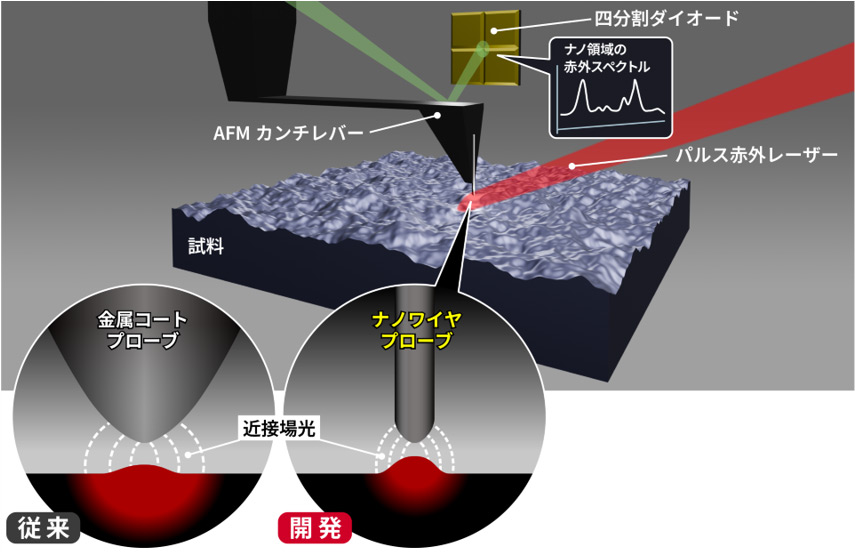
Despite advancements in near-field spectroscopies, achieving reliable nanoscale chemical analysis remains a significant challenge. Atomic force microscopy–based infrared (AFM-IR) microscopy has shown promise for nanoscale characterization; however, its resolution is limited by conventional metallic probes, which have a diameter of several tens of nanometers. To overcome this limitation, we have developed a nanowire-based AFM-IR microscopy. This approach uses chemically synthesized noble metal nanowires as resonant mid-infrared antenna, which enable the generation of highly confined near-fields. As a result, this technique significantly improves spatial resolution and detection sensitivity across a variety of samples. Our findings illustrate that nanowire-based AFM-IR is a powerful and broadly applicable platform for nanoscale IR spectroscopy, with potential implications for soft matter, two-dimensional materials, and biomolecular systems.
Abstract
Atomic force microscopy–based infrared (AFM-IR) microscopy has emerged as a powerful tool for nanoscale chemical imaging, combining the topographical precision of AFM with the molecular specificity of IR spectroscopy. However, its performance is still limited by conventional metal-coated AFM probes, which provide only modest near-field enhancement, ultimately restricting both spatial resolution and chemical sensitivity. In this work, we present a nanowire-based AFM-IR approach that overcomes these limitations by introducing a probe design: Chemically synthesized noble metal nanowires are affixed to the tip of a standard AFM cantilever. These nanowires support Fabry–Pérot resonances, functioning as mid-IR antennas that generate strongly confined optical near-field, thereby enhancing spatial resolution and sensitivity. The probe design also enables stable AFM-IR operation on both hard and soft materials. We demonstrate significantly improved imaging and spectroscopic performance, achieving spatial resolution below 10 nm and sensitivity at the submonolayer level. These findings establish nanowire-based AFM-IR microscopy as a highly promising platform for superresolution vibrational spectroscopy, with broad applications ranging from soft matter and two-dimensional materials to biomolecular analysis.