2026-05-07 ペンシルベニア州立大学(Penn State)
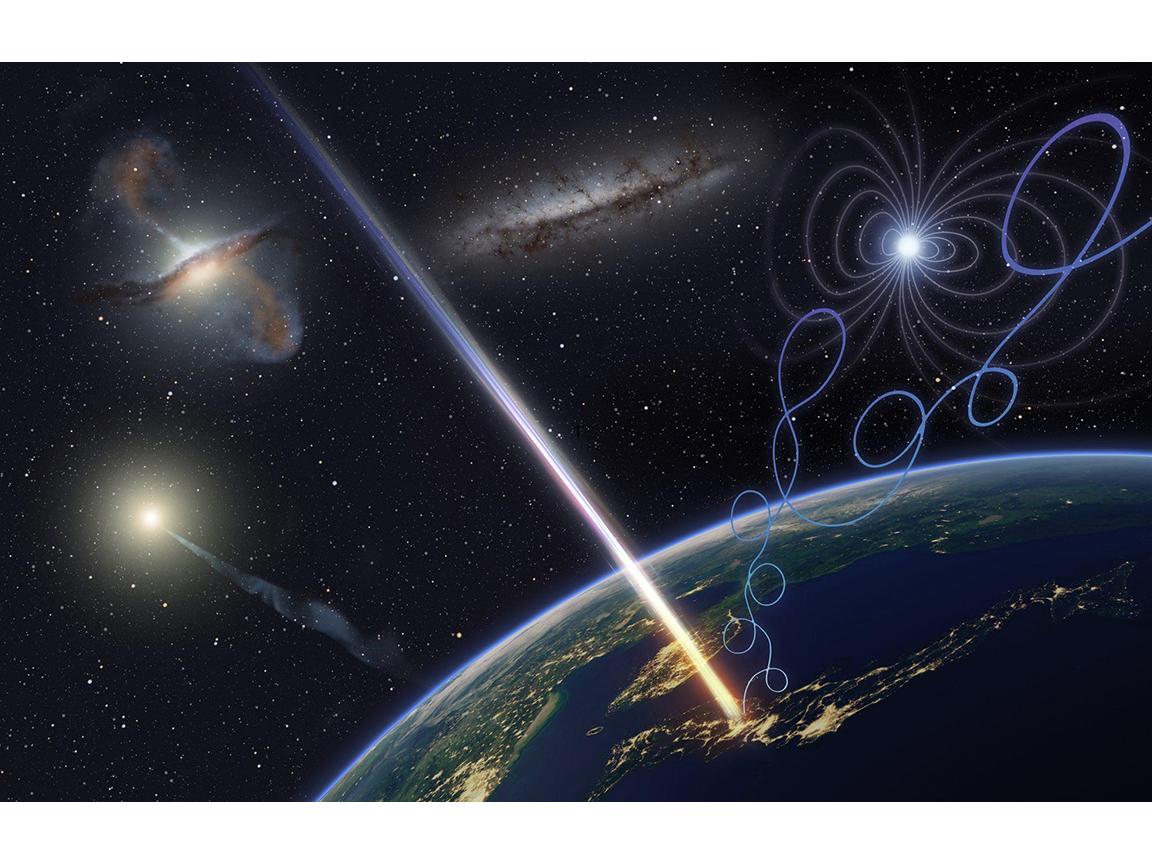
Artist’s impression of an ultra-high energy cosmic ray reaching Earth. New research suggests that some of the highest-energy cosmic rays may consist of atomic nuclei heavier than iron. The background depicts candidate source objects for these cosmic rays, such as active galactic nuclei and strongly magnetized neutron stars. Credit: Osaka Metropolitan University/Kyoto University L-INSIGHT/Ryuunosuke Takeshige. All Rights Reserved.
<関連情報>
- https://www.psu.edu/news/eberly-college-science/story/ultrahigh-energy-cosmic-messengers-may-carry-ultraheavy-secrets
- https://journals.aps.org/prl/abstract/10.1103/221m-gvs3
超重超高エネルギー宇宙線 Ultraheavy Ultrahigh-Energy Cosmic Rays
B. Theodore Zhang, Kohta Murase, Nick Ekanger, Mukul Bhattacharya, and Shunsaku Horiuchi
Physical Review Letters Published: 7 May, 2026
DOI: https://doi.org/10.1103/221m-gvs3
Abstract
We investigate the propagation of ultraheavy (UH) nuclei as ultrahigh-energy cosmic rays (UHECRs). We show that their energy loss lengths at ≲300 EeV are significantly longer than those of protons and intermediate-mass nuclei, and that the highest-energy cosmic rays with energies beyond ∼100 EeV, including the Amaterasu particle, may be UH-UHECRs. For the first time, we derive constraints on the contribution of UH-UHECR sources, and find that the current data are consistent with energy generation rate densities of UHECRs from collapsars and neutron star mergers. Our model predicts that the mean value of the depth of shower maximum is lower than that for iron nuclei beyond 100 EeV, which can be tested with future composition measurements, e.g., AugerPrime and the Global Cosmic Ray Observatory. In addition, the spectral tension between the Telescope Array (TA) and the Pierre Auger Observatory can be alleviated by considering the enhanced contribution of UHECRs—including UH nuclei—from a nearby transient.