2026-05-01 沖縄科学技術大学院大学
© ダン・ダニエル
<関連情報>
- https://www.oist.jp/ja/news-center/news/2026/5/1/explosive-evaporation-unlocks-new-possibilities-3d-printing-and-chemical-analysis
- https://www.pnas.org/doi/10.1073/pnas.2538161123
潤滑された表面上の液滴の自発的なクーロン分裂 Spontaneous Coulomb fissions of drops on lubricated surfaces
Marcus Lin, Peng Zhang, Aaron D. Ratschow, +2 , and Dan Daniel
Proceedings of the National Academy of Sciences Published:April 30, 2026
DOI:https://doi.org/10.1073/pnas.2538161123
Significance
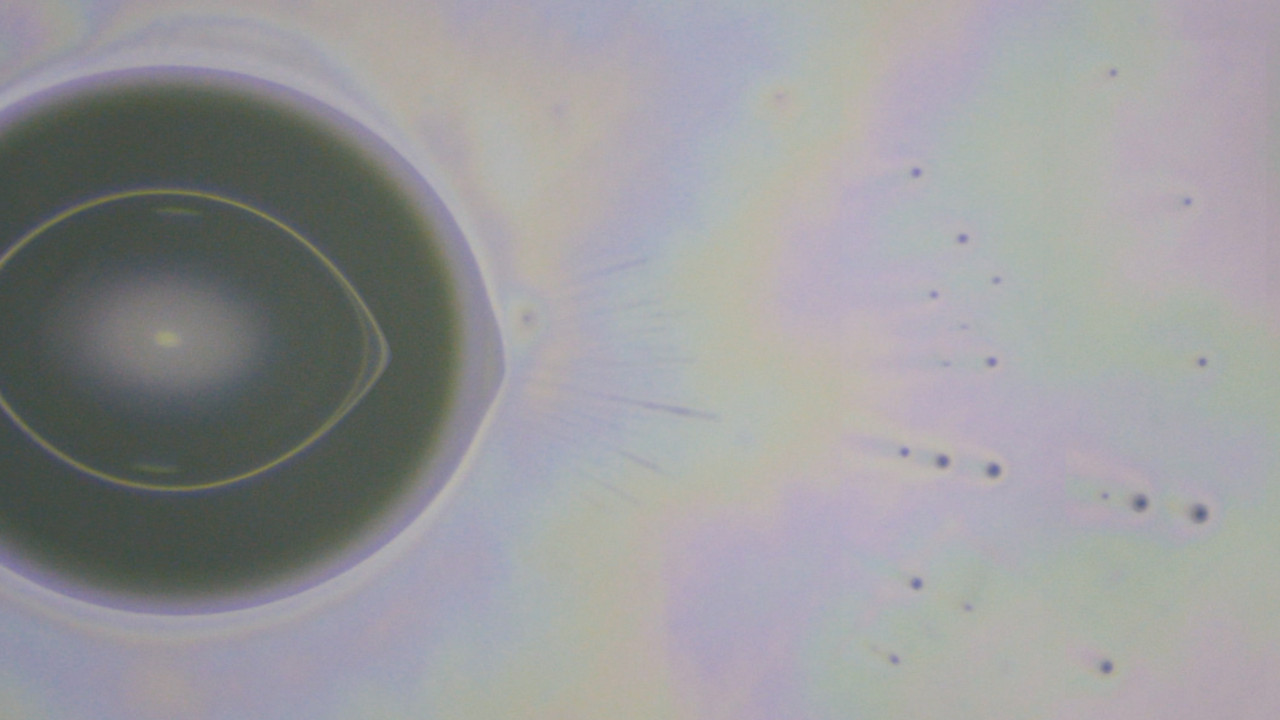
When water rubs against a solid surface, it naturally acquires electric charges. Yet their influence during evaporation remains poorly understood and is often overlooked. This study uncovers a striking phenomenon: during evaporation, charged millimetric water drops can spontaneously emit fine liquid jets which break up into microdroplets—provided that surface friction is eliminated, such as by lubricating plastic material with a thin oily layer. Evaporation concentrates the charge until electrostatic forces overcome surface tension, triggering this instability. The finding potentially unlocks applications from nanoscale fabrication to electrospray ionization.
Abstract
Charged water drops are more widespread than commonly acknowledged. For example, raindrops typically carry charges of order Q~1 pC, while routine pipetting in the laboratory produces drops with Q~50 pC. Here, we show that such modest charging can spontaneously generate periodic Coulomb fissions for evaporating water drops on lubricated surfaces, with more than 60 successive cycles observed over 30 min. Interestingly, the underlying instability can be quantitatively predicted by two fissility thresholds: one marking the onset of drop elongation and another triggering fission. Each fission culminates with a fine liquid jet that disintegrates into 40 to 50 microdroplets, expelled within microseconds. The phenomenon spans an extraordinary range of length scales (from millimeters to microns) and time scales (hours to microseconds), with broad potential applications ranging from nanoscale fabrication to electrospray ionization.