2026-04-22 東京科学大学
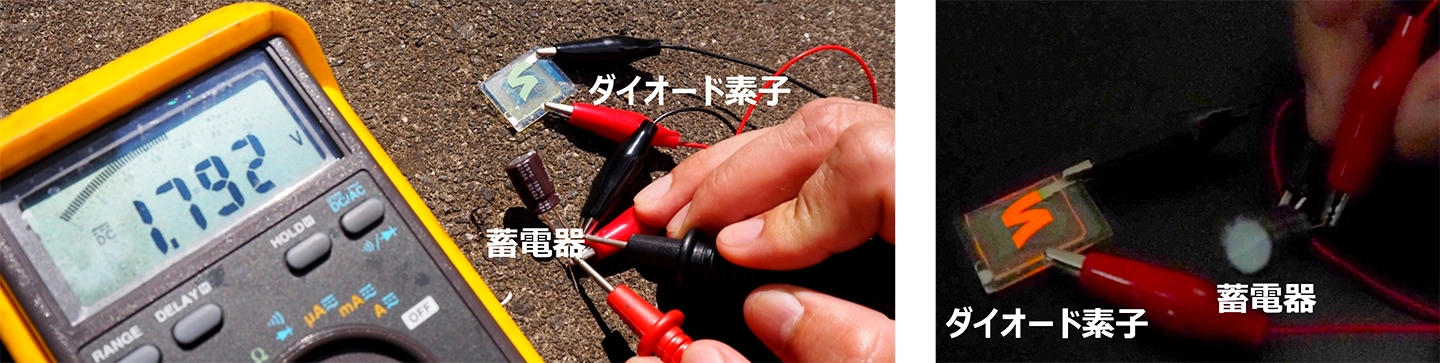
図1. 同一素子で太陽光の下で発電し電気を貯め、自分自身で貯めた電気で発光する様子
<関連情報>
- https://www.isct.ac.jp/ja/news/yio8cwcbqq7q
- https://advanced.onlinelibrary.wiley.com/doi/10.1002/adma.72995
高発光性有機太陽電池が理論限界電圧に近づき、多機能エネルギーハーベスティングディスプレイを実現 Highly-Emissive Organic Photovoltaics Approaching Theoretical Limit Voltage and Enabling Multifunctional Energy-Harvesting Displays
Qing-Jun Shui, Naoya Aizawa, Jinyao Xu, Atsuko Nihonyanagi, Daigo Miyajima, Ken-ichi Nakayama, Yutaka Majima, Seiichiro Izawa
Advanced Materials Published: 20 April 2026
DOI:https://doi.org/10.1002/adma.72995
ABSTRACT
Simultaneous light emission and energy harvesting in a single organic diode are critical for multifunctional optoelectronic devices such as light-harvesting displays. However, their realization has been limited by severe non-radiative recombination losses of excited states. Here, we report highly-emissive organic photovoltaics employing donor and acceptor molecules in which the frontier molecular orbitals are alternately localized on adjacent atoms, thereby preserving high triplet energies while minimizing structural relaxation associated with bond stretching. These features suppress non-radiative recombination, enabling both photovoltaic power conversion efficiency and electroluminescence (EL) external quantum efficiency exceeding 1%. Non-radiative recombination rates are reduced by more than five orders of magnitude compared to state-of-the-art organic photovoltaics, allowing the devices to generate a high voltage close to the Shockley–Queisser limit. Furthermore, the same device exhibits red EL at 620 nm with a low turn-on voltage at 1.7 V and luminance above 1000 cd/m2. These results establish a general design principle for efficient organic multifunctional diodes, opening a route to compact, efficient, and versatile optoelectronic platforms that can rival inorganic multifunctional diodes.