2026-04-15 ノースウェスタン大学
<関連情報>
- https://news.northwestern.edu/stories/2026/4/bottled-lightning-makes-a-cleaner-fuel
- https://pubs.acs.org/doi/10.1021/jacs.6c04425
プラズマ・触媒・液体界面におけるメタンの直接部分酸化 Direct Partial Oxidation of Methane at Plasma-Catalyst-Liquid Interfaces
James Ho,Stephanie Pecaut,Wesley D. Beck,Matthew Hershey,Linsey Seitz,and Dayne F. Swearer
Journal of the American Chemical Society Published: April 15, 2026
DOI:https://doi.org/10.1021/jacs.6c04425
Abstract
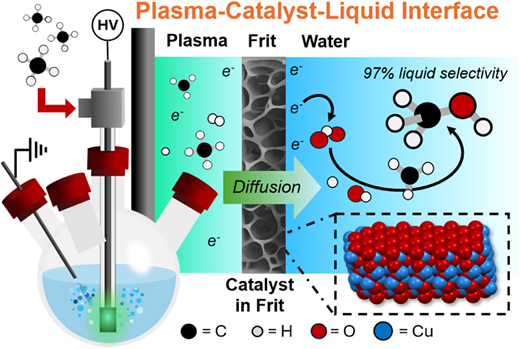
The direct and partial oxidation of methane to value-added chemical fuels, such as methanol, remains a major yet lucrative challenge in catalytic chemistry. Herein, we introduce engineered plasma-catalyst-liquid interfaces (PCLIs) that enable a one-step, ambient-pressure, electrified pathway for methane oxidation to methanol and higher-order hydrocarbons. By integrating a CuO-infused porous glass frit coupled with a nonthermal methane plasma at an aqueous interface, we demonstrate the importance of mass transfer of plasma-activated species to the catalyst surface in controlling oxidative selectivity. Following systematic experiments of reaction conditions, we report an optimized liquid-phase methanol selectivity of 96.8 ± 0.6% (highest total selectivity = 57.9 ± 5.5%) with a simultaneous production rate of 51.8 ± 1.5 mmolMeOH gCuO–1 hr–1. Additional gas-phase production of H2 and C2+ hydrocarbons (e.g., ethane, ethylene, propane, propylene) was measured with a notable absence of overoxidized products (i.e., CO2) under optimized reaction conditions. A specific electricity consumption of 46.7 kWh/kgMeOH indicates competitive efficiency for electrified methane upgrading. Plasma diagnostics, including charge-voltage Lissajous analysis, optical emission spectroscopy, and plasma modeling, reveal a complex mechanistic picture where CuO-stabilized biradical coupling, gas-phase radical recombination, and vibrationally “hot” methane compete for overall reaction selectivity as a function of the pulsed plasma discharge. This study demonstrates the importance of modulating plasma chemistry and transport between plasma, catalyst, and liquid to improve reaction outcomes under complex multiphase environments.