2026-04-15 中国科学院(CAS)
<関連情報>
- https://english.cas.cn/newsroom/cas-in-media/202604/t20260415_1157370.shtml
- https://www.nature.com/articles/s41550-026-02836-3
極端なスピンダウン率を持つミリ秒パルサーが、スピンアップ理論に厳しい検証を突きつける Stringent tests of spin-up theories posed by a millisecond pulsar with an extreme spin-down rate
Qingdong Wu,Na Wang,Jianping Yuan,Guoliang Lü,Di Li,Pei Wang,Weiwei Zhu,Richard N. Manchester,Shuangqiang Wang,Chenchen Miao,Mengyao Xue,Chunhua Zhu,Dongxiang Shen,Wenming Yan,Zhigang Wen,Kejia Lee,Chengmin Zhang,Jumei Yao,Rai Yuen,Jingbo Wang,De Zhao,Feifei Kou,Shengnan Sun & Jiarui Niu
Nature Astronomy Published:08 April 2026
DOI:https://doi.org/10.1038/s41550-026-02836-3
Abstract
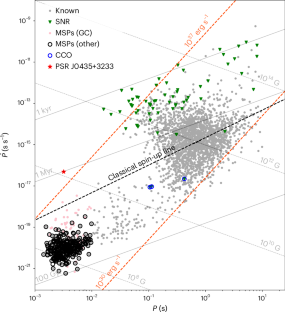
Binary millisecond pulsar systems are superb probes of stellar, binary evolution and the physics of extreme environments. The location of millisecond pulsars relative to the ‘spin-up line’ in the spin period and spin-down rate (P–Ṗ) diagram plays a critical role in understanding population studies of radio millisecond pulsars and accreting neutron stars in X-ray binaries. Here we report the discovery of the pulsar PSR J0435+3233, which exhibits an exceptionally high spin-down rate of 4.8775101(2) × 10−17 s s−1—two orders of magnitude higher than that of other known millisecond pulsars, thus occupying a distinctive position in the P–Ṗ diagram. This discovery implies a formation channel that differs from the classical evolutionary path, challenging the theoretical models of the recycling process and placing stringent constraints on spin-up theories. One plausible scenario is that its progenitor was a neutron star undergoing super-Eddington accretion, with the currently observed pulsar being a remnant of such a system. Another possible mechanism is its formation through the accretion-induced collapse of a magnetized ONeMg white dwarf, although this scenario requires specific theoretical assumptions. Hence, PSR J0435+3233 has an important impact on binary evolution theory.