2026-04-09 京都大学
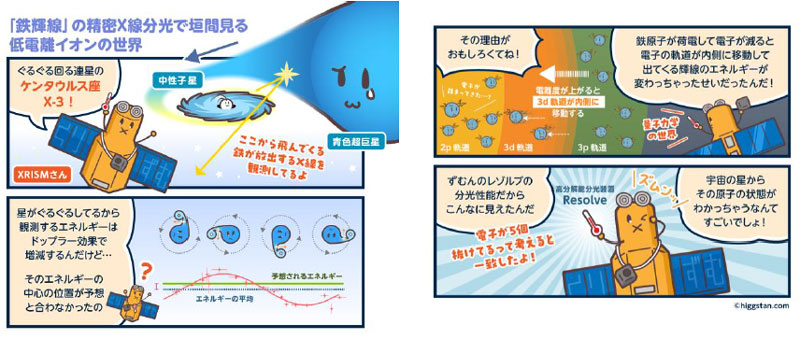
本研究の概要
<関連情報>
- https://www.kyoto-u.ac.jp/ja/research-news/2026-04-09-1
- https://www.kyoto-u.ac.jp/sites/default/files/2026-04/web_2604_Enoto-fe367012234b8937a01e8d9d968ce0b8.pdf
- https://academic.oup.com/pasj/article/78/2/735/8508728
XRISM によって示された、ケンタウルス座X-3における低電離を原因とするFeK蛍光輝線のエネルギーシフト Energy shift of Fe-K fluorescence lines due to low ionization demonstrated with XRISM in Centaurus X-3
Yutaro Nagai ,Teruaki Enoto ,Masahiro Tsujimoto ,Hiroya Yamaguchi ,Yuto Mochizuki ,Ehud Behar ,Lia Corrales ,Paul A Draghis ,Ken Ebisawa ,Natalie Hell,…
Publications of the Astronomical Society of Japan Published:06 March 2026
DOI:https://doi.org/10.1093/pasj/psag015
Abstract
The Feα K fluorescence line at 6.4 keV is a powerful probe of cold matter surrounding X-ray sources and has been widely used in various astrophysical contexts. The X-ray microcalorimeter spectrometer onboard XRISM can measure line shifts with unprecedented precision of ~0.2 eV, equivalent to a line-of-sight velocity of ~10 km s-1. At this level of accuracy, however, several factors that influence the line energy must be carefully considered prior to astrophysical interpretation. One such important factor is the ionization degree, Feq+. The Kα line shifts redward by ~4 eV as q increases from 0 (neutral) to 8 (Ar-like). Additionally, the accompanying Fe Kβ line at 7.06 keV shifts blueward by ~30 eV from q=0to 8. We demonstrate that this effect is actually observable in the XRISM data of the high-mass X-ray binary Centaurus X-3 (Cen X-3). We advocate that the differential energy shift between the Kα and Kβ line provides a robust estimate of q by decoupling from other effects that shift the two lines in the same direction. We derived q ~5(Sc-like) for the fluorescing matter by comparing the observation with atomic structure calculations of our own and in the literature. By accounting for the derived charge state and the corresponding shift in the rest-frame line energy, we made corrections for this effect and reached a consistent residual shift among the Kα, Kβ, and the optical measurement attributable to the systemic velocity of the system. Consequently, we obtained a new constraint on the location of the cold matter. This ionization effect needs to be assessed in all use cases of the Fe Kα line shift beyond Cen X-3, and the proposed metric is generally applicable to all of them.