2026-04-06 物質・材料研究機構,東京科学大学,高知工科大学
<関連情報>
- https://www.nims.go.jp/press/2026/04/202604060.html
- https://www.nims.go.jp/press/2026/04/avpavq0000004gmc-att/202004060.pdf
- https://pubs.acs.org/doi/10.1021/acs.jpclett.6c00357
表面電場勾配に基づくオルト-パラ水素変換触媒の探索 Exploring Ortho–Para Hydrogen Conversion Catalysts Based on Surface Electric Field Gradient
Hiroshi Mizoguchi,Yuichi Shirako,Shusaku Shoji,Hideki Abe,Takeshi Fujita,and Hideo Hosono
The Journal of Physical Chemistry Letters Published: March 11, 2026
DOI:https://doi.org/10.1021/acs.jpclett.6c00357
Abstract
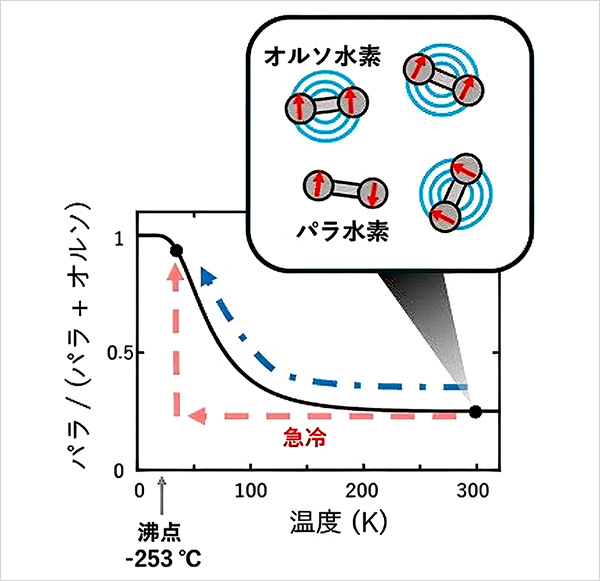
According to our hypothesis that ortho (O) to para (P) hydrogen conversion is promoted by an inhomogeneous electric field on the surface of the insulating oxide with high ionicity, we searched for OP conversion catalysts using lattice energy as an indicator of high ionicity. As a result, we found new oxide catalysts, including SiO2, γ-Al2O3, and CeO2 combined with 3d late transition metal cocatalysts. The fraction of para-H2 on 5%Fe-loaded SiO2 powder reached 50% (equilibrium value at 77 K) within 20 min. The activities of these catalysts are significantly superior to those of benchmark catalysts, such as Mn3O4. The cocatalyst nanoparticles of 1–12 nm size dispersed on the oxide catalysts adsorb hydrogen well without dissociating it. The nuclear spin state of ortho-H2 adsorbed at the asymmetric site (nonzero electric field gradient) of the oxide surface is thermally excited by nuclear quadrupole interaction, and the OP conversion rate is increased by nuclear spin relaxation.