2026-04-02 ワシントン大学セントルイス校
米ワシントン大学セントルイス校の研究は、「ダークラディエーション」がニュートリノとして観測されている可能性を示した。通常、宇宙背景放射などの観測から推定されるニュートリノの振る舞いに不一致があり、未知の軽い粒子が存在する可能性が指摘されてきた。本研究では、この未知成分がニュートリノに似た信号として検出されている可能性を理論的に検討した。
この仮説が正しければ、宇宙のエネルギー構成や初期宇宙の進化理解に大きな影響を与える。ダークラディエーションの存在は、標準模型を超える新物理の証拠となる可能性があり、宇宙論と素粒子物理の双方に重要な示唆を与える成果である。
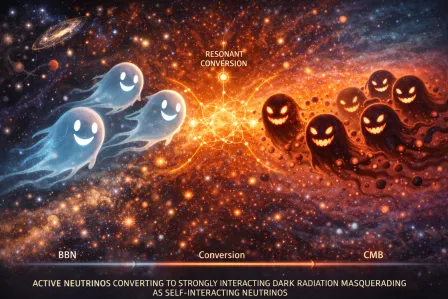
Illustration of neutrinos converting into dark radiation in the early Universe.
<関連情報>
- https://source.washu.edu/2026/04/ghostly-particles-is-dark-radiation-masquerading-as-neutrinos/
- https://mcss.wustl.edu/news/ghostly-neutrinos?_ga=2.68918929.1233487560.1775359382-390609397.1773716162
- https://journals.aps.org/prl/abstract/10.1103/jprg-jll6
ニュートリノに紛れ込んだ偽物:自己相互作用ニュートリノを装った暗黒放射 Impostor among Neutrinos: Dark Radiation Masquerading as Self-Interacting Neutrinos
Anirban Das, P. S. Bhupal Dev, Christina Gao, Subhajit Ghosh, and Taegyun Kim
Physical Review Letters Published: 2 April, 2026
DOI: https://doi.org/10.1103/jprg-jll6
Abstract
Multiple cosmological observations hint at neutrino self-interactions beyond the standard model, yet such interactions face severe constraints from terrestrial experiments. We resolve this tension by introducing a model where active neutrinos resonantly convert to self-interacting dark radiation after BBN but before CMB epoch. This exploits the fact that cosmological observables cannot distinguish between neutrinos and dark radiation with the same abundance and free-streaming properties. Our mechanism, based on a simple type-I seesaw framework along with a keV scale scalar mediator, achieves two objectives: (i) it produces strongly self-interacting dark radiation that imitates neutrino self-interactions favored by cosmological data, and (ii) it depletes the active neutrino energy density, relaxing cosmological neutrino mass bounds and easing the tension with neutrino oscillation data. The model naturally evades laboratory constraints through suppression of the neutrino-mediator coupling by the squared mass ratio of active and sterile neutrinos. We show that this scenario is favored over ΛCDM by the combined Planck and DESI data, while being consistent with all other constraints. Our mechanism is testable in future laboratory probes of absolute neutrino mass and searches for sterile neutrinos.