2026-03-12 日本原子力研究開発機構
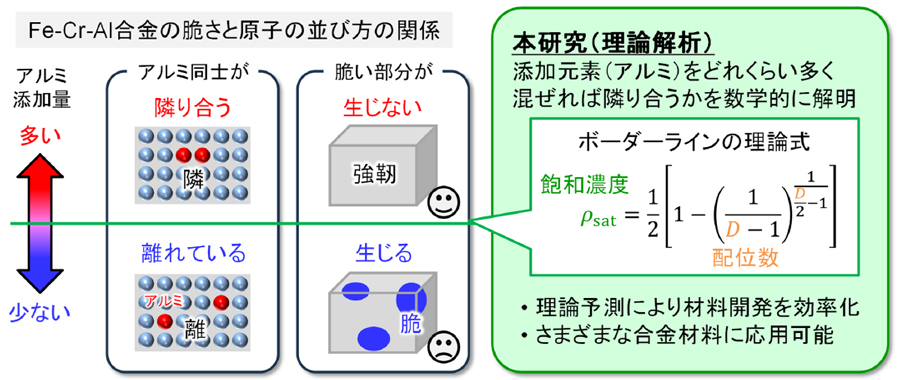
本研究の概念図 添加元素が「隣り合う/離れている」状態となるボーダーライン(飽和濃度)を理論予測することで、合金材料の強靭化に貢献できる
<関連情報>
固溶体中の反発性ドーパントの飽和率のグラフ理論的解析 Graph-theoretic analyses of saturation fraction of repulsive dopants in solid solutions
Atsushi Kubo & Yosuke Abe
Scientific Reports Published:12 March 2026
DOI:https://doi.org/10.1038/s41598-025-30829-1
Abstract
Short-range order (SRO) of dopant atoms in alloys or solid solutions is one of the most essential factors for materials design. In various alloy materials, dopant atoms repel each other, which causes a non-neighboring SRO and results in a substantial effect on their material properties. The fraction of repelling dopants should have an upper bound to satisfy the non-neighboring placement, where dopants are, as it were, saturated. Such “saturation fraction” is expected to play an important role in composition design for alloys. However, no comprehensive understanding has been established thus far for the saturation fraction of repulsive dopant elements despite its practical importance. Here we show that the saturation fraction of repulsive dopant can be described universally by several simple parameters regarding the lattice structure. We conducted a series of stochastic simulation and mathematical analysis for random packing of repulsive dopant in lattice systems for the purpose of predicting the saturation fraction. The mathematical model, which is based on random graph, successfully reproduced the basic trend of the saturation fraction for a variety of lattice structures. The present analyses can provide new insights into composition design for various kinds of alloys such as multi-principal element alloys.