2026-03-06 ジョージア大学
<関連情報>
ウェアラブル技術の進歩:MXeneベースの多機能・バイオメディカルスマートテキスタイル Advances in Wearable Technology: MXene-Based Multifunctional and Biomedical Smart Textiles
Nishat Sarmin Rupanty,Joyjit Ghosh,Tasneem Noor,Tanvir Rahman Asif,Sayef Ahmed,Sadhin Howlader,and Vladimir Reukov
ACS Omega Published: December 29, 2025
DOI:https://doi.org/10.1021/acsomega.5c08488
Abstract
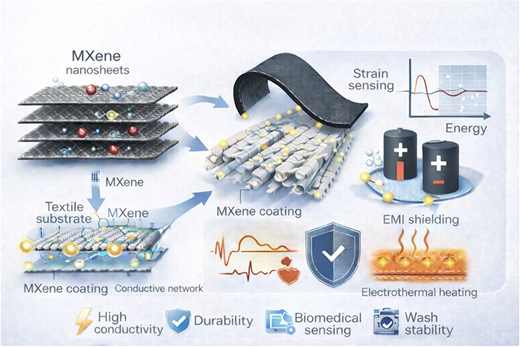
The two-dimensional transition metal carbides, nitrides, and carbonatites known as MXenes have become a revolutionary class of materials for developing multipurpose wearable electronic fabrics, or e-textiles. Their remarkable mechanical flexibility, hydrophilicity, customizable surface terminations, and electrical conductivity make them perfect for incorporation into a variety of textile substrates. This review paper provides a thorough examination of MXene structures, synthesis pathways, and surface chemistry, emphasizing how these properties affect performance in textile applications. Scalability, homogeneity, and durability are evaluated for a variety of integration techniques, including dip coating, spray coating, printing, electrospinning, layer-by-layer assembly, and composite production. A wide range of applications, such as extremely sensitive strain and pressure sensors, energy storage and harvesting devices, electromagnetic interference (EMI) shielding, thermal management systems, antimicrobial and medical textiles, and communication interfaces, demonstrate the versatility of MXene-based e-textiles. In addition to durability issues, including oxidation resistance, wash stability, and mechanical robustness, special emphasis is placed on performance parameters such as conductivity, gauge factor, shielding effectiveness, and thermal response. Lastly, the paper outlines potential approaches to creating sustainable, biocompatible, and commercially viable MXene-integrated textiles, while discussing existing limitations, including cytotoxicity, environmental stability, and limitations of large-scale production. Through the integration of materials science, textile engineering, and application-driven design, MXenes has the potential to transform the next generation of innovative fabrics for consumer electronics, healthcare, and defense.