2026-03-03 スタンフォード大学
<関連情報>
- https://news.stanford.edu/stories/2026/03/3d-printing-fusion-reactor-energy-efficiency
- https://www.nature.com/articles/s41586-024-07061-4
ロールツーロール方式による形状特異的粒子の高解像度3Dプリント Roll-to-roll, high-resolution 3D printing of shape-specific particles
Jason M. Kronenfeld,Lukas Rother,Max A. Saccone,Maria T. Dulay & Joseph M. DeSimone
Nature Published:13 March 2024
DOI:https://doi.org/10.1038/s41586-024-07061-4
Abstract
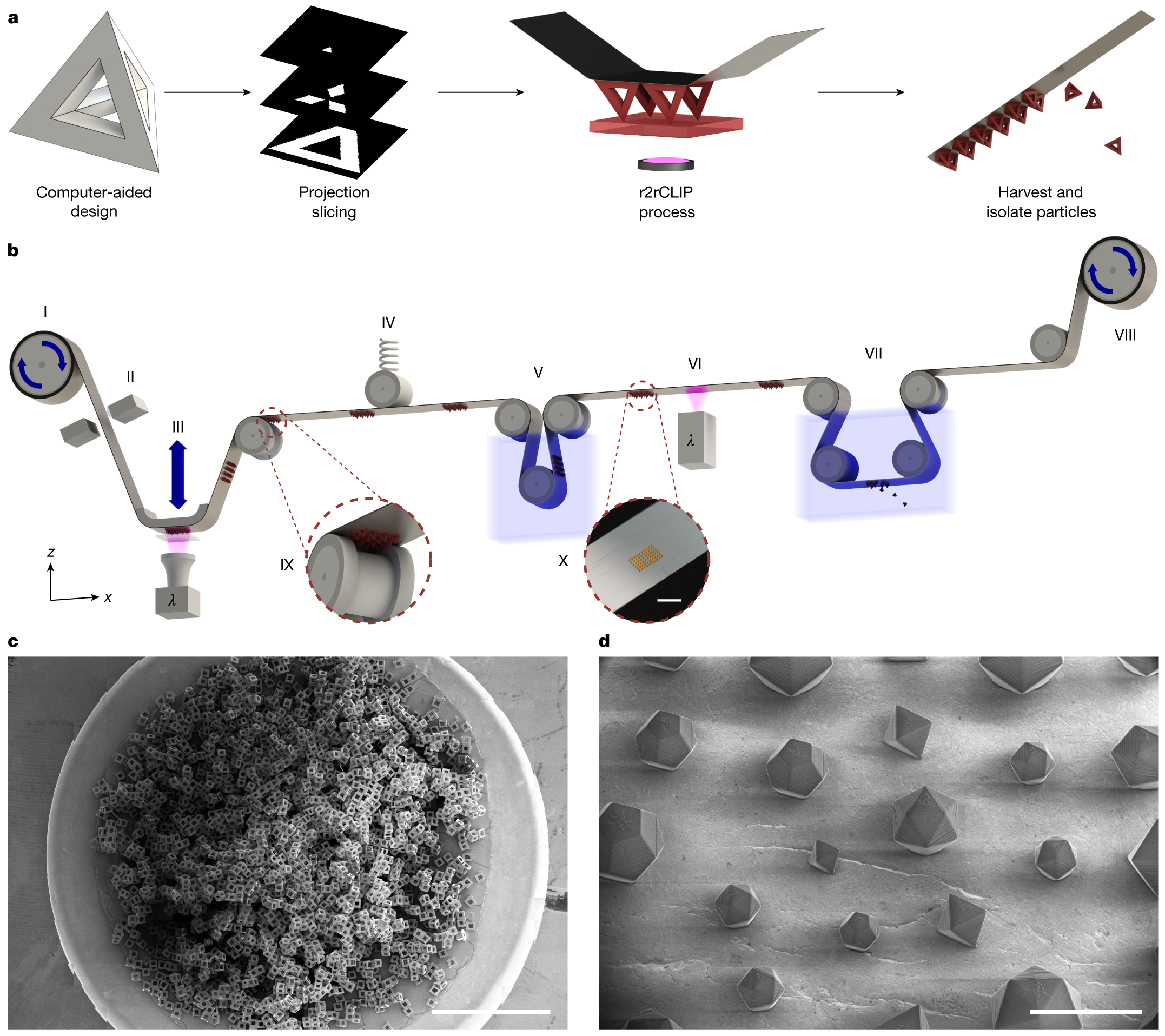
Particle fabrication has attracted recent attention owing to its diverse applications in bioengineering1,2, drug and vaccine delivery3,4,5, microfluidics6,7, granular systems8,9, self-assembly5,10,11, microelectronics12,13 and abrasives14. Herein we introduce a scalable, high-resolution, 3D printing technique for the fabrication of shape-specific particles based on roll-to-roll continuous liquid interface production (r2rCLIP). We demonstrate r2rCLIP using single-digit, micron-resolution optics in combination with a continuous roll of film (in lieu of a static platform), enabling the rapidly permutable fabrication and harvesting of shape-specific particles from a variety of materials and with complex geometries, including geometries not possible to achieve with advanced mould-based techniques. We demonstrate r2rCLIP production of mouldable and non-mouldable shapes with voxel sizes as small as 2.0 × 2.0 µm2 in the print plane and 1.1 ± 0.3 µm unsupported thickness, at speeds of up to 1,000,000 particles per day. Such microscopic particles with permutable, intricate designs enable direct integration within biomedical, analytical and advanced materials applications.