2026-03-02 中国科学院(CAS)
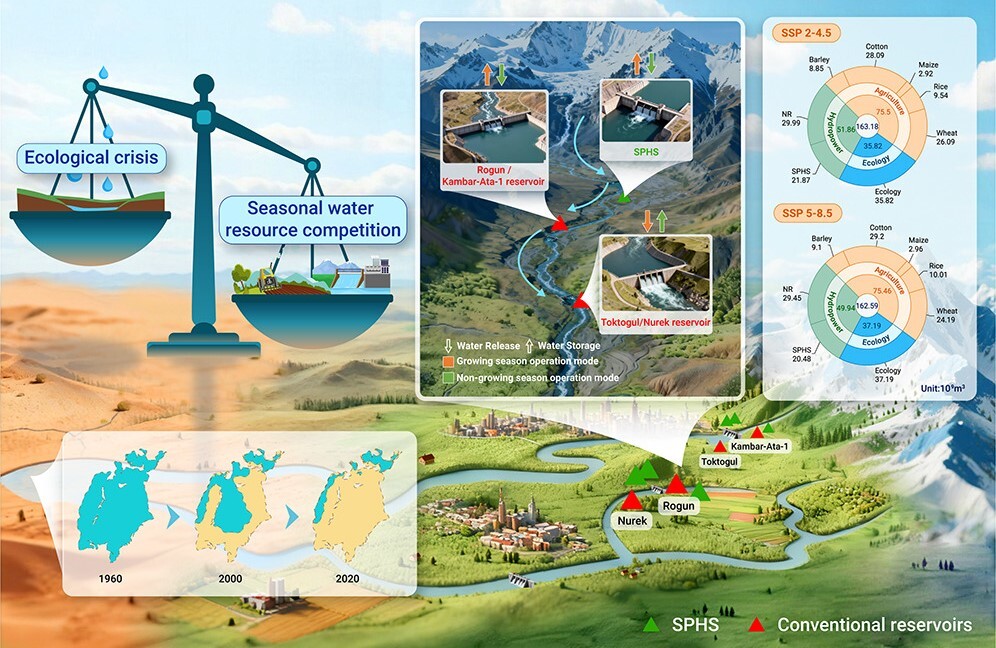
Schematic diagram for water resources in the Aral Sea Basin. (Image by XIEG)
<関連情報>
- https://english.cas.cn/newsroom/research-news/202603/t20260305_1151480.shtml
- https://www.cell.com/the-innovation/fulltext/S2666-6758(26)00004-4
A transboundary water allocation strategy for the Aral Sea Basin: Integrating the water-food-energy-environment nexus
Yanan Hu ∙ Guangdong Sun ∙ Weili Duan ∙ … ∙ Wei Wei ∙ Philippe De Maeyer ∙ Peter L.M. Goethals
The Innovation Published:January 7, 2026
DOI:https://doi.org/10.1016/j.xinn.2026.101257
Public summary
- Coupling conventional reservoirs with seasonal pumped hydropower storage helps alleviate water competition.
- Water allocation optimization achieved relative equity (Gini < 0.29), balancing food, hydropower, and ecology.
- Trade-offs exist between benefits and water equity, while benefits are related to greenhouse gas emissions.
Abstract
Water resource competition has disrupted sustainable development in the Aral Sea Basin, necessitating integrated strategies for the water-food-energy-environment nexus to address challenges from ongoing climate change, ecological restoration, growing food demand, and potential hydropower projects impacting water stability. This study developed a multi-objective optimization model to address these issues. Results showed relatively equitable water allocation, with Gini coefficients consistently below 0.29 across all scenarios. Agricultural water use ranged from 71.71 to 80.53 × 10⁹ m3, while seasonal pumped hydropower storage reservoirs increased upstream controllable water to 42.91–58.47 × 10⁹ m3 (35%–44%). Hydropower remained stable owing to reservoir coordination. However, to ensure ecological flows (35.38–37.78 × 10⁹ m3), crop areas should be reduced by 14.37%–21.05% under SSP2-4.5 and 16.16%–23.93% under SSP5-8.5. A trade-off emerged between benefits and water allocation equity, particularly in high-emission, low-inflow scenarios, alongside a positive correlation between benefits and greenhouse gas emissions. These findings emphasize the critical need for integrated management of the Aral Sea Basin’s interconnected resource systems.